


I went to Queenstown with a question that fills forums and planning spreadsheets: do you actually need a car here, or can you lean on buses, shuttles and your own feet? To find out, I booked central accommodation and committed to doing the bulk of my stay without driving, only adding wheels when the public transport web clearly frayed. What followed was a week of blissfully simple lakefront strolls, some very cheap rides, and a few long, chilly waits staring down empty roads.
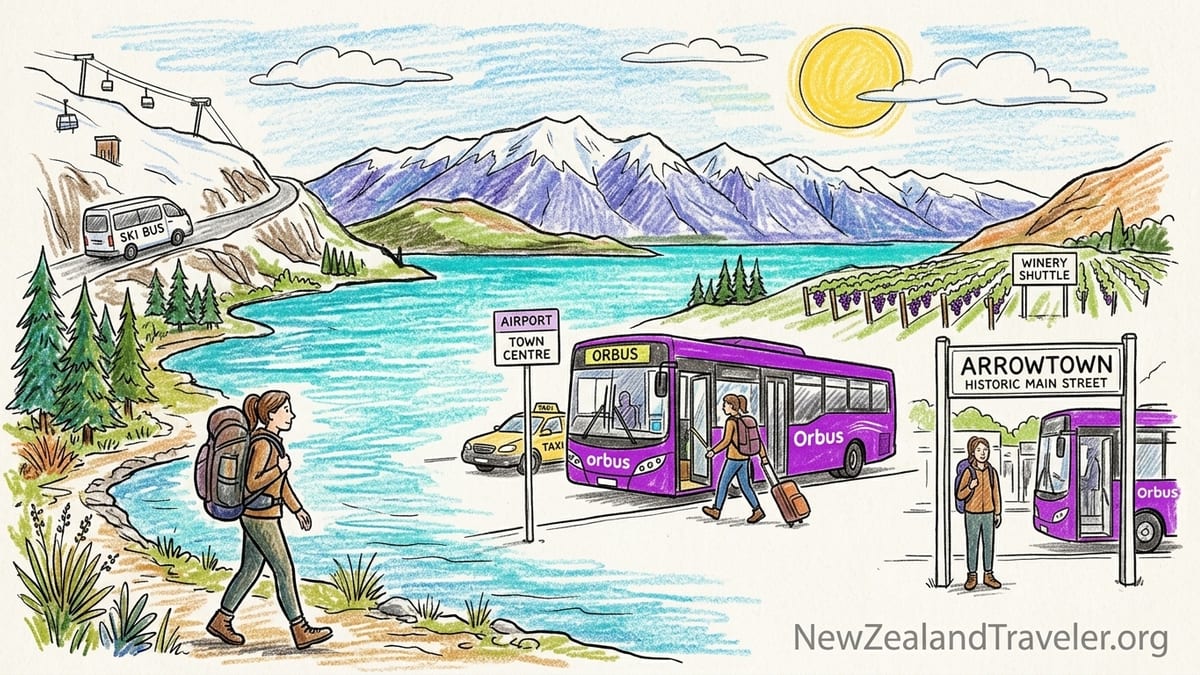
First Impressions: Landing In Queenstown Without Car Keys
The car free experiment started at the airport. Queenstown Airport sits only a short drive from town, and its bright purple Orbus service has become the default answer to the airport transfer problem for locals and budget conscious visitors. Buses generally run around every 15 minutes during the day on the main airport route, and the fare difference between paying cash and using a Bee Card is striking. With a registered Bee Card, an adult airport trip is currently about NZ$2.50. Pay cash on board and you are looking at roughly NZ$10 for the exact same seat. By comparison, the airport itself estimates a taxi into central Queenstown at about NZ$50 to NZ$85 depending on traffic, route and time of day.
I bought my Bee Card at the airport, which cost a small purchase fee and required a minimum top up, then walked straight to the clearly signed Orbus stop outside the terminal. Even with checked luggage, the process felt stress free. The bus was clean, luggage went easily into the standing area, and in around 20 minutes I was stepping off on Camp Street, a short roll of my suitcase from my hotel. For a solo traveler, the cost difference between NZ$2.50 and up to NZ$85 is the price of a decent dinner with wine.
The only minor friction was timing. Although the headline frequency is about every 15 minutes during the day, that smooth pattern stretches in the early morning and later at night. I landed around midday and had a wait of less than 10 minutes. Other travelers I spoke to who arrived after 9pm described a more noticeable pause, standing under cool alpine air while taxis darted in and out of the rank.
Still, as a first taste of car free Queenstown, the airport transfer felt like a win. Cheap, simple, and no hunting for a rental counter or worrying about insurance before even seeing the lake.
Staying Central: When Queenstown Becomes A Walkable Resort Town
I deliberately chose a hotel within a five minute walk of the lakefront as a stress test of how much you can do in Queenstown with nothing but your feet. This is where car free Queenstown shines. The compact core wraps around the edge of Lake Wakatipu, and most of the places first time visitors care about sit within a flat, easy walk: the main bar and restaurant streets around Shotover and Beach Street, the lakefront trail toward Queenstown Gardens, and the departure points for many cruises and activity boats.
Across several days I walked to everything from budget burger joints to smart bistros, and never once wished I had a car waiting. In the evenings the lakefront was buzzing, with live music drifting out of bars, and walking let me stop, linger and detour for gelato or hot chips without calculating parking limits. The town center is busy in peak seasons and parking here can be a hassle, so being car free actually felt like an upgrade rather than a compromise.
Most of the classic “Queenstown activities” solved the transport issue for me before it even arose. My jet boat ride on the Shotover River included pickup from a central spot less than a block from my hotel. A half day rafting trip bundled transport from the same area to the river base and back again. Even a scenic lake cruise in a vintage style vessel departed right from the central wharf. Operators expect that many visitors will not drive, so they quietly wrap buses and vans into the product, and the cost simply appears in the package price you see online or at the booking desk.
Grocery shopping was the real test of daily life. From my hotel it was roughly a ten minute walk to a compact supermarket in the center, using a reusable bag as a pseudo backpack. With two people sharing the load this was easy. For families or self catering groups, however, the story changes. One evening I watched a couple with two small kids push an overflowing trolley to the kerb and then try to juggle it into a taxi. Queenstown’s supermarkets in Frankton and the outskirts have better range and prices, but reaching them comfortably without a car can involve a longer Orbus ride and some planning, which might not be ideal with tired children.
Testing The Network: Arrowtown, Gibbston And Beyond By Bus
One of the most common worries for car free visitors is whether you can see Arrowtown and the Gibbston wine region without driving. I dedicated a full day to this. Early in the morning I caught an Orbus service that runs out toward Arrowtown, joining a quiet mix of commuters and a few other visitors. The ride took around 25 to 35 minutes depending on stops, and the Bee Card fare remained in that low single digit range that starts to feel almost implausible when you compare it to rental car rates or rideshares.
Arrowtown itself is wonderfully walkable. From the bus stop it was a short stroll to the historic main street and the Chinese settlement by the river. I wandered through cafes and small museums, walked riverside trails, and never once needed motorised transport until it was time to leave.
From Arrowtown into the Gibbston Valley the picture is less straightforward. There is no frequent public bus cruising from cellar door to cellar door. Instead, wineries and tour operators fill the gap. For this trip I booked a return shuttle to a major winery that departs from central Queenstown and sometimes arranges pickups from Arrowtown by prior request. The shuttle cost around NZ$45 return from Queenstown for transport alone, with packages available that bundle tastings or tours on top. The journey took about 30 minutes each way, following the Kawarau River through a landscape of cliffs and vines.
At the winery the model worked beautifully. Tastings, a tour through wine caves and lunch filled several hours, and then the same shuttle took us back to town. The constraint came if you want to visit multiple wineries independently. Without a car, hopping between several cellar doors in Gibbston on your own timetable is awkward. You can book group wine tours that stop at three or four venues in one loop, but then you share timing with twenty other people and your stay at each vineyard is fixed. If you are the sort of traveler who likes to linger over another glass when the sun hits the terrace just right, that lack of flexibility can grate.
Ski Season Without A Steering Wheel: Buses, Gear And Early Starts
Skiing is where the “no car in Queenstown” experiment really meets resistance. The region has several major ski fields within about ninety minutes of town, including Coronet Peak and The Remarkables near Queenstown and Cardrona further over the Crown Range. Dedicated ski buses operate to each, run either by the mountain operators or partner transport companies. These buses are designed to take the driving, snow chains and alpine road stress off visitors, especially those unused to winter conditions.
To test how realistic this feels across several days, I booked two ski days in Queenstown, one at Coronet Peak and one at The Remarkables, both using the Queenstown Ski Bus from town. A return bus ticket cost in the region of several dozen dollars per day for an adult, roughly comparable to a share of fuel and parking costs if you are in a small group, but excellent value for solo travelers. The buses picked up from central locations and several hotels along Frankton Road, and the onboard staff helped people slot skis and boards into the underfloor lockers.
On the plus side, the system works. I never touched a steering wheel, never carried snow chains, and I could relax on the ride while watching the landscape peel past. On busy powder days, being on the ski bus meant I did not have to worry about the mountain carparks filling and turning late arrivers away. For first timers and nervous winter drivers, that peace of mind is significant.
The friction is timing and logistics. Ski buses run on fixed schedules, with early morning departures that can feel brutally sharp if you are coming from a late dinner the night before. In one case I found myself waiting outside my hotel in the cold before sunrise, hugging my rental boots and skis, which are heavy and unwieldy when carried more than a few dozen metres. After the lifts closed the return services filled fast. On one afternoon at The Remarkables, the queue for outbound buses snaked around the base building, and several people waited for a second or third departure to secure seats. Everyone eventually made it down, but it involved more standing, shuffling and guessing than sliding on snow.
Cardrona, further away toward Wānaka, magnifies these factors. The bus ride is longer and leaves earlier, turning a ski day into a longer commitment. For keen skiers who want the flexibility to chase different mountains based on daily conditions, mix in a half day, or stop at viewpoints on the Crown Range road, a rental car for at least part of the trip starts to look logical. For beginners or occasional skiers happy to accept the fixed schedule, the buses remain entirely workable.
Everyday Friction: Groceries, Trailheads And Evenings Out
Outside the headline activities, car free life in Queenstown introduces a softer layer of friction. Groceries are one example. While there are small supermarkets in the town center, the larger and better priced stores sit in Frankton, near the main highway and airport. Reaching them without a car is technically easy using Orbus, but the practical experience involves timing your shopping to bus schedules, carrying heavy bags onto and off busy services, and walking the last stretches. Couples and solo travelers often absorb this easily by shopping more frequently and buying less each time, but families or groups self catering in apartments might find the routine tedious.
Trail access is another pressure point. Central Queenstown sits on beautiful lakeside paths and has the Queenstown Hill and Ben Lomond tracks climbing almost from town, both of which can be reached by foot or a short taxi. If your hiking ambitions stretch further, to trailheads along the Glenorchy road or out past Kelvin Heights, public transport thins quickly. Some guided walks include hotel pickups, but those who prefer to choose trails on the morning based on the weather and their energy levels will find the bus network limiting.
Evening transport also becomes a factor the moment you stay outside the very core. Central accommodation allowed me to walk back from dinners and bars in a few minutes. Travelers staying along Frankton Road or in the residential fringe may need to rely on evening Orbus services or taxis. Buses continue to run into the night, but not always at 15 minute frequencies, and standing in the cold after 10pm waiting for a half hourly service can dull the glow from an otherwise wonderful meal.
I spoke with one couple staying in a lakeside apartment between town and Frankton who described a pattern of using Orbus happily during the day, then defaulting to rideshares at night to avoid long waits with kids. Over a week, those individual fares accumulated into a noticeable line item on their budget, narrowing the cost advantage of skipping a rental car.
Where Car Free Queenstown Truly Shines
Despite those frictions, there are scenarios where a car free approach to Queenstown does not feel like a compromise at all. If your focus is on the core highlights that first put the town on global bucket lists, you can structure a stay so that nearly everything is walkable or bundled with transport. A couple staying three or four nights in a central hotel, planning one or two big ticket adventures such as a jet boat ride, a Milford Sound or Doubtful Sound flight cruise package, and an afternoon of wine tasting on an organised tour, will barely notice the absence of a car.
Operators have clearly designed products with this in mind. Many Milford Sound day trips include coach or minibus pickup from central Queenstown, a scenic drive or flight, the cruise, and return. Lake activities depart from within a few hundred metres of the main pedestrian streets. Even things like canyon swings and zipline experiences have shuttles or gondolas starting essentially in town, eliminating any expectation that guests arrive in their own vehicles.
Financially, central and short stays tilt strongly toward ditching the car. When you factor in Orbus at NZ$2.50 with a Bee Card for most local trips, free hotel pickups, and the reality that you can walk almost everywhere in the compact CBD, a standard rental car at peak season prices can feel like paying handsomely for something that will sit in an underground garage while you are elsewhere. Parking fees and the risk of tickets for overstaying central time limits add to that calculation.
From an environmental and stress perspective, car free Queenstown can also be satisfying. Alpine towns suffer when every additional visitor chooses to drive and park at the same times, and stepping onto buses and shared shuttles felt tangibly lighter. If you are the sort of traveler who values low stress over maximal flexibility, simply not dealing with left hand driving, alpine roads and winter conditions has genuine value.
Where The Gaps Show: Scenic Roads And Independent Exploring
The more your Queenstown ambitions expand beyond the tight ring of lakefront and flagship tours, the more you notice where the transport web thins out. Scenic drives are a classic example. The road along Lake Wakatipu toward Glenorchy is one of the great day drives of New Zealand, with countless informal bays and lookouts where the water and peaks line up beautifully. There are tour companies that run half day trips out here, but going independently by bus is far more difficult, and you lose the freedom to stop wherever a riffle of light catches the water.
The same is true of the back roads that connect Arrowtown, Crown Range viewpoints and side valleys dotted with farm gates and small producers. Without a car you can still see some of these places on organised tours, but the sense of improvisation goes missing. Buses and shuttles run on timetables and fixed circuits. Rental cars let you pull over when lupins erupt beside the road, when a small cafe sign appears, or when skies clear unexpectedly after a morning of low cloud.
Winery hopping brings that into focus. Tour buses through Gibbston deliver a very good introduction to the region, but if you want to plot a day where you bike between cellar doors, linger at some and skip others, and perhaps stay on at one for an early dinner, having your own vehicle and a designated driver, or combining car use with bike rental, usually works better. Shuttle services are great at solving point to point transport for one venue or a planned route. They are less nimble when you want to treat each hour as negotiable.
This is where some travelers start to regret a vow to stay entirely car free. A couple I met on a cruise had attempted a ten day stay in the Queenstown region relying only on Orbus and tour buses, and by day six they were feeling fenced in. They had ticked off the headline activities, skied two days, and made it to Arrowtown, yet still could not reach several roadside lookouts and walks along the lake that looked temptingly close yet impractical by public transport.
The Takeaway
After a week of walking pavements, tapping a Bee Card on Orbus, lugging skis onto buses and timing shuttles to wineries and ski fields, I came away with a rule that might help you decide where you sit on the “do you need a car in Queenstown” spectrum.
If you are staying in central Queenstown for three to four nights, focusing on lakefront strolling, restaurant hopping, one or two blockbuster activities that include transport, and perhaps a single day trip that picks up in town, you genuinely do not need a car. Book central accommodation, buy a Bee Card at the airport, use the frequent airport bus instead of a taxi, and let included shuttles do the work. Your trip will likely be cheaper and calmer for it.
If you are planning a week in the area and want to mix easy urban days with deeper exploring, rent a car for only one or two days rather than for your full stay. Use buses and walking for Queenstown itself and any bundled tours, then concentrate your independent driving on a Glenorchy day, a Crown Range loop via Arrowtown, or flexible winery exploring. This hybrid model avoids paying for a car that mostly sleeps in a carpark while still unlocking the region’s scenic roads and quieter corners when it matters.
If your dream is a full Queenstown region road trip taking in multiple lakes, side valleys, scattered trailheads and off peak photo stops, and you bristle at fixed tour schedules, you will probably regret trying to do the entire thing by bus. Orbus and activity shuttles are excellent at moving people along the main corridors and into major experiences, but they are not designed to support improvised, highly flexible itineraries over a week or more. In that scenario, accept that you are a driver, budget accordingly, and perhaps still lean on the ski buses in winter if you prefer to avoid alpine roads on snow days.
FAQ
Q1. Is the Queenstown airport bus really a good alternative to a taxi?
The Orbus airport service is excellent value, with Bee Card fares currently a fraction of a taxi’s NZ$50 to NZ$85 estimate into central Queenstown. If you are traveling light or as a couple and arriving during daytime or early evening, it is the obvious choice. Larger families with bulky luggage or late night arrivals may still prefer a taxi or rideshare for convenience.
Q2. Where should I stay in Queenstown if I do not plan to rent a car?
If you are committed to a car free stay, aim for accommodation within an easy five to ten minute walk of the lakefront and the main streets around Camp Street and Shotover Street. From here you can walk to most restaurants and bars, reach activity departure points on foot, and access Orbus routes without long uphill or roadside walks.
Q3. Can I visit Arrowtown without a car?
Yes. Regular Orbus services connect Queenstown with Arrowtown at Bee Card fares that are very affordable. The trip takes around half an hour. Once there, the historic main street, museum, cafes and riverside walks are all within comfortable walking distance of the bus stop, making Arrowtown one of the easiest side trips from Queenstown without driving.
Q4. How can I see Gibbston Valley wineries if I do not drive?
Without a car, you will rely on winery shuttles and organised wine tours that depart from central Queenstown. Some major wineries offer return shuttles for a fixed per person fee, and group tours typically include three or four cellar doors in a loop. This works very well if you are happy with a structured itinerary, but less so if you want free form hopping between many vineyards on your own schedule.
Q5. Are ski buses from Queenstown reliable enough for a multi day ski trip?
Ski buses run daily in season to Coronet Peak, The Remarkables and Cardrona, and they are widely used by visitors and seasonal workers. When the weather cooperates, they are a dependable way to reach the slopes without driving. The main compromises are early starts, fixed departure times, queues at busy periods and the need to carry ski gear between your accommodation and pickup stops.
Q6. Is Queenstown walkable in winter, or do I need a car because of the cold?
Central Queenstown remains very walkable in winter. The compact layout means most central hotels, restaurants and activity points are only a few minutes apart on foot. Paths are generally well maintained, and you can dress for the conditions with layers and good footwear. A car will not save much time in the dense core, though it can help reach more distant sights or supermarkets more comfortably in poor weather.
Q7. How practical is grocery shopping without a car?
For solo travelers and couples staying centrally, grocery shopping without a car is manageable using small local supermarkets and buying less per trip. Larger full service supermarkets in Frankton are reachable by Orbus, but you will need to time your visit to the bus timetable and be comfortable carrying bags on and off. Families or groups planning extensive self catering may find a short car rental or occasional taxi run for big shops more practical.
Q8. Can I reach popular hiking trails around Queenstown using buses and shuttles?
You can easily reach Queenstown Hill, Ben Lomond and lakeside paths from the town center by walking or a short taxi. Trails further out, such as along the Glenorchy road or in more remote valleys, are difficult to access using public transport alone. Some guided hikes include pickup in Queenstown, but independent walkers wanting a range of trailheads will find a car or arranged transfer very helpful.
Q9. Will I save money overall by skipping a rental car?
On a short, central stay focused on walkable attractions and tours that include transport, you are likely to save money by relying on Orbus, airport buses and hotel pickups. Over longer stays, especially if you add frequent taxis, multiple day trips and group ski bus fares, the savings narrow. A hybrid approach where you rent a car for only one or two key days often balances cost and flexibility best.
Q10. Who should absolutely plan on renting a car in Queenstown?
Travelers who want to design their own multi day road trip, explore scenic roads at their own pace, visit scattered wineries and farm gates, or access varied hiking trailheads will benefit from renting a car. Trying to execute that kind of flexible, region wide itinerary solely with public buses and shuttles is likely to feel constrained and frustrating, even though the services themselves are reliable for more focused trips.