


I planned a Wellington Region trip thinking the base decision would be simple: stay in Wellington city, then bolt on one day in wine country and one day at the beach. Instead, where I slept ended up shaping everything: how early I started, how much I spent on transport, what I ate after dark, and even whether I felt like I was “on holiday” at 8pm or already done for the day. Wellington city, Martinborough, and the Kāpiti Coast aren’t just three points on a map. They’re three very different ways to experience the same region and they each change the rhythm of your trip in ways you notice immediately.
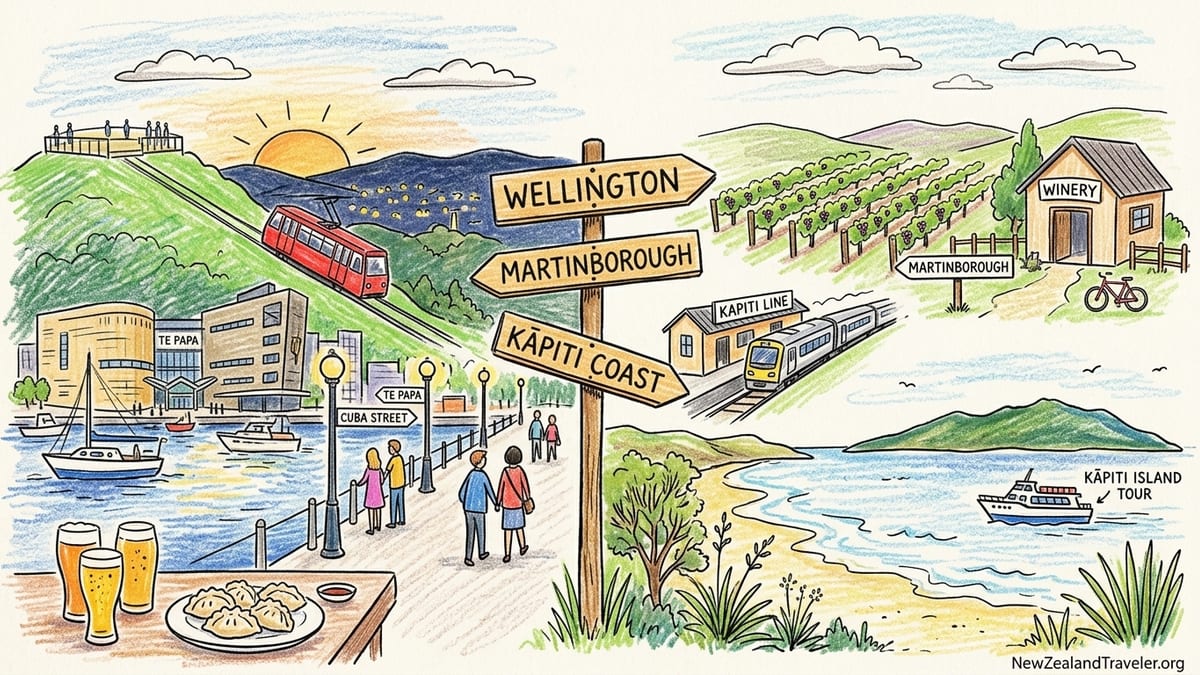
Wellington City: The Car-Light Base That Stays Awake After Dark
When I based myself in Wellington city, I felt like I could start traveling the minute I checked in. That’s partly because so much is walkable and partly because the city’s best “first day” activities don’t require perfect weather or a car. I could land, drop my bag, and be on the waterfront at Te Papa within the hour. Te Papa’s visitor hours are 10am to 6pm daily, which made it easy to build a day around museum time without waking up at dawn, and international visitors aged 16+ pay an entry ticket (New Zealand residents don’t). The important point for base planning is that the city gives you reliable, full-day options even if you arrive late or the wind is doing its famous Wellington thing.
Accommodation in Wellington felt like it rewarded planning more than location. Staying central meant I could treat transit as optional: breakfast on Cuba Street, an afternoon wander along the waterfront, then dinner without once checking a timetable. But the trade-off was cost and parking pressure. Even if you’re not renting a car, you’ll still feel the price of being central when you compare a compact city hotel room with what the same nightly spend can get you in Martinborough or on the coast. If you do have a car, the CBD experience is simplest when you don’t touch it again until you leave, because parking can become its own daily project.
Restaurant access in the city was the biggest practical advantage. In Wellington, I could decide at 7:30pm that I wanted dumplings, craft beer, or dessert and still have options within a short walk or quick rideshare. That matters because it changes how you plan your days. In Wellington, I was comfortable booking an early evening Te Papa visit, a later Wētā Workshop Experiences tour out in Miramar, and still counting on dinner afterwards. Wētā Workshop Experiences advertises an online price from NZ$59 for its Wellington tour, and it’s the kind of paid attraction that fits neatly into a city-based itinerary because transport options are frequent and the “what do we do after?” question has many answers.
The evening atmosphere is where Wellington city truly feels like a base, not just a place to sleep. Even when I did “big day” activities, the city still gave me a second chapter: a stroll on the waterfront, a nightcap, or live music. That’s why I’d put Wellington at the top of the list for first-time visitors and for travelers who want to keep things car-light. If your idea of a good trip includes museums, food, nightlife, and the ability to pivot when the weather changes, the city makes it easy to stay flexible.
Wellington by Day, Not by Night: What Changes When You Sleep Elsewhere
The clearest surprise in this comparison is how different Wellington feels as a day visit versus an overnight base. On days when I slept in Martinborough or on the Kāpiti Coast, Wellington became something I had to “fit in,” even if I was still spending time there. I found myself asking questions I never asked while staying in the city: What time do I need to leave to beat commuter traffic? Where will I park? Do I want to come back later for dinner, or should I eat near my accommodation and accept a quieter evening?
Transport logistics are the dividing line. Wellington city makes it easy to keep moving with short hops: buses in the CBD, the cable car, rideshares, or simply walking. But once you sleep outside the city, the return trip becomes the anchor. If you’re driving, you’re thinking about the hour you’ll spend on the road at the end of the day. If you’re on public transport, you’re thinking about the last connection. That extra layer doesn’t ruin the day, but it changes the mood. Wellington becomes a “daytime hub” rather than the place you naturally drift back into at 9pm.
Costs also shift when Wellington isn’t your overnight base. You might save on accommodation outside the CBD, but you spend more on the mechanics of access: fuel, parking, or booked transfers. Those costs can hide until you do the math on a multi-day stay. I also noticed the little cost differences that accumulate: spontaneous café stops in the city are easy when you’re already there, but when Wellington is a day trip you tend to cluster spending into one big lunch and one paid activity because you’re more schedule-driven.
This is why, even though official travel planning material often frames Wairarapa and Kāpiti as the two major overnight extensions to a central Wellington stay, it’s worth treating the base decision seriously. If you start with Wellington as your core base, you can add Martinborough and Kāpiti as day trips or one-night add-ons. If you invert it and sleep outside the city, Wellington becomes the add-on. That single decision changes your evenings, your flexibility, and the way you experience the region’s energy.
Martinborough: Wine Country Days, Early Starts, and a Quieter Nightlife
Martinborough felt like a different kind of holiday immediately: slower roads, long lunches, and bikes leaning against fences. But it also demanded more commitment. The town rewards travelers who plan to sleep there, because the entire experience is built around daytime winery visits and unrushed meals rather than late-night variety. Many cellar doors keep fairly classic daytime hours, and several of the most recognizable names sit within an easy cycling radius if you’re staying near the square. As a concrete example of the pace, Palliser Estate’s Martinborough cellar door hours are listed as open seven days, 11am to 4pm, with the kitchen running 11am to 3:30pm. Ata Rangi lists a 10am to 4pm cellar door window and notes that it does not offer food, which is exactly the kind of detail that matters when you’re planning your day and deciding whether to book a lunch winery versus a tasting-only stop.
Because winery hours cluster into a relatively tight span, I found my Martinborough days started earlier than my Wellington city days. Even if the first tasting wasn’t until late morning, I wanted to be on the bike and moving, not still waiting for breakfast service. This is where Martinborough differs from the city: in Wellington, I could let the morning unfold and still have a full day. In Martinborough, the best rhythm was: breakfast early, bike out, tasting, lunch, another tasting, then back before the afternoon closes. If I tried to start at noon, the day felt rushed.
Accommodation in Martinborough also shaped the mood. Staying near the town square made it easy to reach dinner on foot and avoid driving after tastings. The Martinborough Hotel is the classic “special weekend” option travelers recognize, and pricing can vary widely by date, room type, and season, but it’s the style of place that signals a couples-focused stay: heritage atmosphere, a short walk to dinner, and a sense of arriving somewhere. That said, the town also has plenty of simpler stays that suit friends traveling for wine and cycling rather than a polished boutique vibe.
Evenings in Martinborough felt distinctly quieter than Wellington. That isn’t a criticism, it’s part of the appeal. After a day of tastings and a long lunch, the town leans into relaxed dinners and early nights. Restaurant access exists, but it’s not the city’s “infinite choice” model. You’ll want at least a soft plan for dinner, especially on weekends, because the options are fewer and the whole region can feel like it’s dining at the same time. For wine-focused couples, groups of friends who want to cycle between cellar doors, and travelers seeking countryside calm, Martinborough works best when you commit to an overnight stay rather than treating it as a rushed day trip.
Martinborough as a Day Trip: The Reality of Transport and Car Dependence
I’ve done Martinborough as a day visit and as an overnight base, and the day-trip version is the one that exposes the practical limitations fastest. If you drive from Wellington, the day is straightforward in the sense that you control your timeline. But it’s also the most car-dependent way to experience a place that’s designed for leisurely tastings. If your group is sharing one vehicle, someone becomes the dedicated driver, and suddenly the quintessential Martinborough experience feels a little lopsided.
Public transport exists, but it requires real attention to connections. A common approach is using the Wairarapa train line to Featherston and then connecting to Metlink Route 200 to reach Martinborough. Metlink explicitly describes Route 200 as linking Martinborough, Featherston, Greytown, and Masterton, and it runs daily. In practice, that train-bus chain can work well for independent travelers who don’t want to drive, but it makes the day more structured. You’re planning around connection times, and you’re more likely to choose wineries you can reach easily from town by walking or cycling rather than trying to “cover the whole region.”
Costs in the day-trip version can cut either way. Driving has fuel and parking, plus the value of your time. Train and bus fares can be reasonable, but you’re trading money for schedule limitations. In both cases, you’re more likely to compress experiences: one headline winery, one long lunch, and maybe a second stop. That’s still enjoyable, but it’s not the same as an overnight stay where you can spread tastings across two days and keep the middle of the day unhurried.
My honest takeaway is that Martinborough as a day trip is best when you’re happy with a “taste of the region” rather than a deep dive. If you want to bike between cellar doors without watching the clock, book a dinner without worrying about the drive back over the Remutaka Hill, and wake up for a second morning of countryside quiet, staying overnight changes the entire feel of the visit.
Kāpiti Coast: Beach Town Ease, Great Walks, and Island Logistics
The Kāpiti Coast gave me something neither Wellington nor Martinborough quite offers: the feeling of space. Even when I wasn’t doing a big activity, just having a beach nearby changed the shape of my day. I could do a morning walk, spend midday on a trail or in a café, and still have time for a sunset beach stroll without feeling like I was “missing” a must-see attraction. As a base, it’s less about ticking off museums and more about having nature as your default setting.
Transport is where Kāpiti is uniquely strong within this three-way comparison. Unlike Martinborough, the Kāpiti Coast is connected to Wellington by the Kapiti Line commuter train, which makes it realistic to stay coastal and still dip into the city for a day. Metlink’s Kapiti Line timetable shows early departures from Wellington on Saturdays, with trains leaving from around 6:14am, which is a meaningful detail if you’re the type who likes sunrise starts or wants to be on a trail early. The flip side is that rail maintenance and bus replacements can happen, especially around holiday periods, so when the coast is your base you develop the habit of double-checking service notices before locking in plans.
Accommodation on the Kāpiti Coast often felt more value-driven than the CBD, especially for families or travelers who want more space. You can find straightforward motels around Paraparaumu Beach and nearby areas that are priced more like a traditional beach town than a capital city center, and that changes what your budget can buy. The vibe is less “weekend city break” and more “coastal reset,” with a practical benefit: parking is typically simpler than in central Wellington, and arriving by car doesn’t immediately create stress.
Evenings on the coast are calmer than Wellington but livelier than you might expect if you assume it’s all day-trippers. Instead of nightlife, the draw is a low-key dinner and an earlier night that sets you up for morning walks, beach time, or an island departure. For families, nature-focused travelers, and anyone who wants beach-and-trail days with the option to ride into the city, Kāpiti works best as an overnight base rather than a rushed day stop.
Kāpiti Island and Early Starts: The Big Reason to Sleep on the Coast
If there’s one experience that most strongly argues for staying on the Kāpiti Coast, it’s Kāpiti Island. The island is a protected nature reserve and a special kind of day, the kind you don’t want to start already tired from a long commute. Kāpiti Island Nature Tours is the name most travelers encounter first, and the operator itself emphasizes that guided tours are the best way to enjoy the island, with options to stay overnight for kiwi spotting. That tone matters: this isn’t a quick ferry shuttle you do on a whim. It’s an organized nature day with fixed departure times, what-to-pack expectations, and a day built around weather and tide conditions.
Prices are a good reality check for planning. The operator’s broader ecosystem of resellers and tourism listings can show slightly different numbers by season and inclusions, but a common published benchmark you’ll see for a classic day tour sits around the NZ$190 to NZ$195 range for adults, with lower child pricing. That’s not a casual add-on, and it’s another reason staying nearby is valuable: you’re already investing in the island experience, so reducing the friction of early transport makes the day feel worth it.
Sleeping on the coast also changes how early you can start your non-island days. I found I naturally woke earlier because the “morning reward” was immediate: a beach walk, a café opening, or a trailhead. In Wellington city, I could start later and still fill the day with museums and restaurants. On Kāpiti, the best moments often felt early: calmer beaches, cooler walking temperatures, and quieter tracks before the day-trippers arrive.
Who does Kāpiti suit most? Families who want beach time without sacrificing access to Wellington. Couples who want nature rather than nightlife. And travelers who want to build a trip around trails and wildlife with one standout day on Kāpiti Island. It’s also a strong pick for repeat visitors to Wellington who have already done Te Papa and Cuba Street and want a second trip that feels like a different destination, not just a repeat of the CBD.
The Takeaway
Choosing Wellington city, Martinborough, or the Kāpiti Coast as your base isn’t about crowning a winner. It’s about deciding what you want to be easy. When I stayed in Wellington city, museums, restaurants, and nights out were effortless and I barely thought about transport. When I stayed in Martinborough, the trip revolved around winery hours, cycling, and long lunches, with quieter evenings that felt intentionally slow. When I stayed on the Kāpiti Coast, nature became the default, mornings started earlier, and Kāpiti Island felt logistically smoother and emotionally bigger because I wasn’t squeezing it into a long commute day.
If you’re visiting the region for the first time and you want variety without a car, Wellington city is the simplest base. If your priority is wine and countryside calm, Martinborough rewards an overnight stay and feels tailor-made for couples and friends traveling specifically to taste and bike. If you want beaches, walks, and wildlife with an easy rail link back to the capital, the Kāpiti Coast is the base that turns Wellington into an optional day trip rather than the whole story.
The best trips I had in this region weren’t the ones where I tried to “do everything” from one bed. They were the ones where I chose a base that matched the pace I wanted, then used the others as day visits or short overnights. The Wellington Region is compact enough to connect, but distinct enough that where you sleep changes the trip more than you expect.
FAQ
Q1. Is Wellington city a good base without renting a car?
Yes. Wellington’s CBD and waterfront are easy to explore on foot, and it’s practical to use buses, rideshares, and short trips rather than driving and parking daily.
Q2. What’s the biggest advantage of staying overnight in Martinborough?
You can spread winery visits across two days, cycle between cellar doors more comfortably, and avoid rushing back to Wellington after tastings and dinner.
Q3. Can I visit Martinborough without a car?
Yes, but it’s more structured. A common approach is taking the Wairarapa train to Featherston and connecting to Metlink Route 200 to Martinborough, then focusing on wineries reachable from town.
Q4. When do Martinborough winery activities typically start?
Many cellar doors operate in daytime windows, commonly late morning through mid-afternoon. Planning an earlier start helps you fit tastings and lunch in before cellar doors close.
Q5. Is the Kāpiti Coast realistic as a base for visiting Wellington city?
Yes. The Kapiti Line commuter train connects Kāpiti towns with Wellington, so you can stay coastal and still do a full city day, especially if you check service notices before you go.
Q6. Why stay on the Kāpiti Coast instead of doing it as a day trip?
Overnight stays make early beach walks and trail starts easy, and they reduce the pressure of doing everything in one day, especially if you’re planning a Kāpiti Island trip.
Q7. How much should I budget for a Kāpiti Island day tour?
A typical published adult price for a guided Kāpiti Island day tour is around the NZ$190 range, though exact pricing can vary by option and season.
Q8. Which base is best for nightlife and late dinners?
Wellington city. It offers the broadest choice of restaurants and bars after dark, while Martinborough and the Kāpiti Coast tend to wind down earlier.
Q9. Which base suits families best?
The Kāpiti Coast is often a strong fit for families because of beaches, open space, and generally easier parking, while still being connected to Wellington by train.
Q10. How do I choose between Martinborough and the Kāpiti Coast for an overnight extension?
Choose Martinborough if your priority is wineries, cycling, and countryside dining. Choose the Kāpiti Coast if you want beaches, trails, and a nature-focused trip anchored by Kāpiti Island.