


Hiring a car in the Waikato is one of the easiest ways to unlock Hobbiton, the Waitomo glowworm caves, Cambridge’s leafy streets and Raglan’s surf breaks on your own schedule. With Hamilton Airport as a compact regional hub and Auckland Airport acting as the country’s main international gateway, visitors have several practical choices to make about where to pick up, what type of vehicle to book and how to keep rental and fuel costs under control.
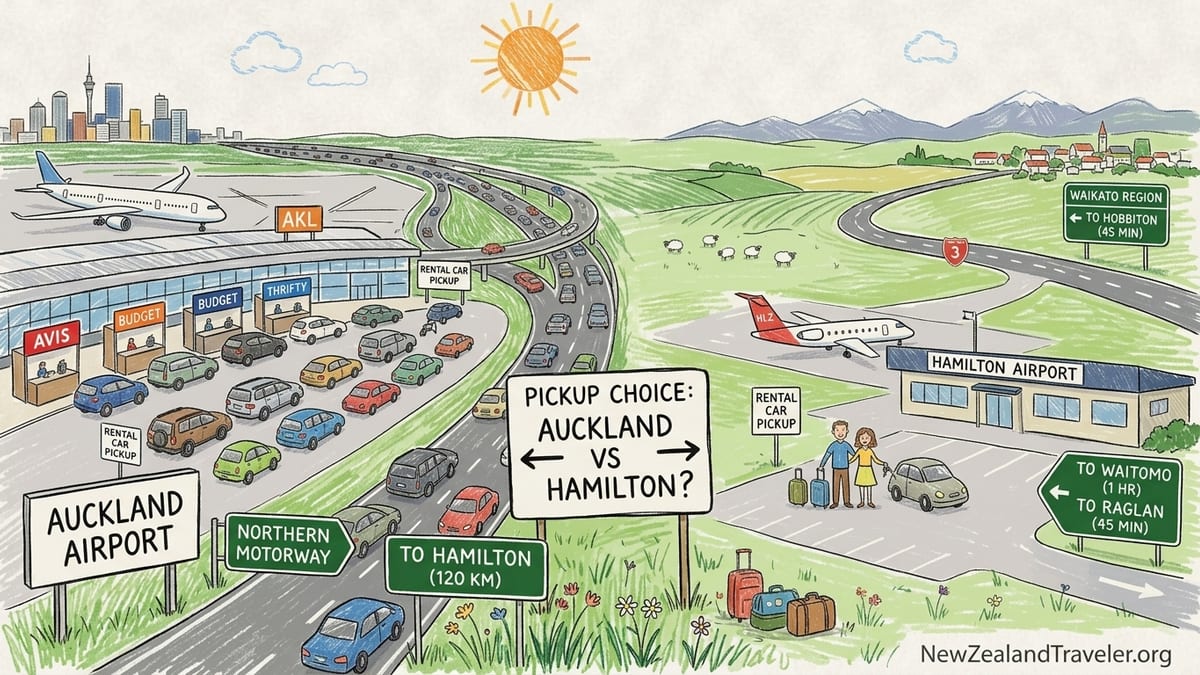
Hamilton Airport vs Auckland Airport: Where Should You Pick Up?
International visitors flying into New Zealand usually arrive at Auckland Airport, about 110 kilometres north of Hamilton by road. In typical traffic, the drive from Auckland Airport to Hamilton takes around 1 hour 20 minutes. Some travellers prefer to pick up a car in Auckland and drive straight to the Waikato, especially if they are continuing further south to Rotorua or Taupo and want to avoid a domestic flight. Others choose to connect to Hamilton by domestic flight or bus and start their road trip with a simpler, quieter pickup at Hamilton Airport.
Hamilton Airport is small and easy to navigate, with short walks from the terminal to rental counters and cars parked just outside. If you are arriving on a regional flight from elsewhere in New Zealand, picking up here keeps things straightforward: no city traffic, no complex airport layout and a quick exit onto State Highway 3 or 21 toward Hamilton, Cambridge or Te Awamutu. For a couple arriving with jet lag and minimal luggage, this can be much less stressful than learning to drive on the left in Auckland’s multi‑lane motorway system.
For long itineraries that loop around the North Island, it can be smarter to keep all rental arrangements at Auckland Airport. For example, if you are landing internationally in Auckland, planning a week around the Waikato and Rotorua, then returning to Auckland to fly onward, a single Auckland Airport rental avoids one‑way drop fees between Hamilton and Auckland. On the other hand, if you are focusing just on the central North Island and flying home from Wellington or Christchurch, starting at Hamilton and ending elsewhere may justify a one‑way rental.
In practice, the decision often comes down to timing and confidence. If your long‑haul flight lands late at night or early morning, it may be better to stay a night near Auckland Airport, then either drive to Hamilton in daylight or take a quick domestic hop and pick up the car when you feel rested. Drivers unused to New Zealand conditions often find rural highways, narrow bridges and variable weather easier to handle once they have slept.
On‑Airport Car Rental at Hamilton: Avis, Budget and Thrifty
Hamilton Airport currently hosts several well‑known rental brands on site, including Avis, Budget and Thrifty. Their desks are in or just beside the terminal building, and vehicles are kept in a signposted car park a short walk away. For a typical visitor arriving on a mid‑morning flight, it is realistic to be driving out of the airport car park within 20 to 30 minutes of landing, assuming you have pre‑booked and your documents are in order.
Pricing at Hamilton Airport tends to move with demand and the wider New Zealand travel seasons. As a very general guide, economy or compact cars might start from around NZD 60 to 90 per day in shoulder seasons, while standard SUVs can easily run from NZD 110 to 180 per day or more in peak summer and school holidays. Booking several weeks ahead and being flexible on vehicle class usually delivers better rates than walking up on the day, when choice may be limited to whatever is left in the car park.
Operating hours at Hamilton Airport are usually tied to scheduled flights. Unlike Auckland, which has 24‑hour operations, some Hamilton rental counters may only stay open around the times their partner airlines are arriving or departing. For example, a late‑evening arrival could find reduced desk hours or staff working on call. Before you finalise flights, cross‑check your rental confirmation to ensure the pickup time falls within the branch’s posted opening hours and that your flight number is included on the booking so staff can track delays.
Most on‑airport rentals at Hamilton will allow you to drive throughout the North Island and, in many cases, across Cook Strait to the South Island if you arrange this in advance. There may be additional charges for ferry use or restrictions on taking the vehicle onto certain unsealed roads. Because many of the scenic side trips from Hamilton involve rural highways and occasional gravel sections, it is worth reading the fine print carefully so you do not accidentally void your insurance cover by heading down a forestry road or informal beach access track.
Choosing the Right Vehicle: Compact vs SUV for Waikato Roads
The Waikato’s main tourist routes are generally well maintained two‑lane highways with clear signage and plenty of passing opportunities. For the classic loop from Hamilton to Hobbiton, Waitomo, Cambridge and Raglan, visitors can comfortably manage with a compact hatchback such as a Toyota Corolla or similar. A small car is easier to park in Hamilton’s central streets, sips less fuel on the open road and is usually the cheapest option when booking from the airport brands.
However, families, surf travelers and photography‑focused visitors may prefer a midsize or full‑size SUV. The extra boot space makes it easier to store large suitcases, tripods, prams or surfboards without blocking rear visibility. Higher ground clearance can be reassuring on short gravel driveways to rural accommodation, farmstays and some Raglan holiday homes. Models like the Toyota RAV4, Mitsubishi Outlander or Hyundai Tucson are commonly available in New Zealand fleets and offer a good compromise between comfort and fuel consumption.
One consideration is New Zealand’s changeable weather. In heavy rain, a slightly larger vehicle with good tyres and modern safety features can feel more secure on winding rural sections between Te Awamutu and Waitomo or along the coast road toward Raglan. That said, most rental compacts sold in the last few years also come with stability control, anti‑lock brakes and multiple airbags. A confident driver familiar with manual or automatic transmissions on the left side of the road will be safe in either category, as long as they adjust their speed to the conditions.
If you are planning to share driving among several adults, it is wise to sit in the actual model offered by the rental counter before leaving the car park. Check that everyone can see the instruments clearly, adjust seats to a comfortable position and reach controls without distraction. For example, a taller driver might find that a compact hatchback feels cramped after two hours on State Highway 1, while a shorter driver could struggle with rear visibility in a large SUV. Taking five minutes to get comfortable at Hamilton Airport can make the drive to Matamata or Raglan far more enjoyable.
Distances, Driving Times and Sample Itineraries from Hamilton
From Hamilton Airport or central Hamilton, most of the Waikato’s star attractions are surprisingly close. Hobbiton Movie Set, near Matamata, typically takes about 45 minutes to drive from Hamilton, depending on which route you choose and current roadworks. Many visitors combine a morning tour at Hobbiton with an afternoon wander through Cambridge’s boutiques and lakeside paths before returning to Hamilton for dinner.
Waitomo, famous for its glowworm caves and black‑water rafting, is roughly one hour’s drive from Hamilton. The route follows State Highway 3 through Te Awamutu and Otorohanga, passing farmland and low rolling hills. A practical day trip might see you leaving Hamilton around 8.30 am, arriving in Waitomo just after 9.30 am for a mid‑morning cave tour, then having lunch in the village and either returning the same way or looping back via Te Kuiti for variety.
Raglan, a laid‑back surf town on the west coast, is around 45 minutes from Hamilton by car. The drive winds past farmland before climbing over the coastal hills and dropping into the harbour. Many road‑trippers plan a relaxed breakfast in Hamilton, a late‑morning arrival in Raglan for a coffee on Bow Street, then an afternoon at Ngarunui Beach or Manu Bay. Because the final coastal stretch is narrower and more winding than the highways to Hobbiton or Waitomo, allow extra time and be ready for slower speeds behind campervans or learner drivers.
Cambridge sits around 20 to 30 minutes from Hamilton, depending on traffic, and can be a convenient base for those who prefer a village feel to a city hotel. From Cambridge, Hobbiton is again roughly 45 minutes away, making it simple to string together a loop: Hamilton to Cambridge, on to Hobbiton, then back through rural roads to Hamilton or south towards Rotorua. With a rental car, you can also make spontaneous stops at roadside farm stalls, viewpoints or small town bakeries that you would otherwise miss on a fixed coach tour.
Understanding Rental Costs, Insurance Excess and One‑Way Fees
Beyond the base daily rate, the biggest variable in a Waikato car rental is often the insurance excess. Most standard contracts with brands like Avis, Budget and Thrifty include basic cover but carry an excess that can run to several thousand New Zealand dollars if you have an at‑fault accident or the car is damaged or stolen. At the counter, you will usually be offered a reduction package that lowers this excess in exchange for an extra daily fee. For example, you might see a quote where the excess drops from NZD 4,000 to NZD 500 for an added NZD 30 to 40 per day.
For a two‑day Hamilton return trip to Raglan and Hobbiton, this extra might not seem worthwhile if you are an experienced driver and comfortable with the risk. However, for a 10‑day itinerary covering Hamilton, Rotorua, Taupo and beyond, the potential out‑of‑pocket cost of a single parking scrape or chipped windscreen can be significant. Some travellers instead rely on a travel insurance policy or a premium credit card that covers rental car excess, but it is essential to read the conditions carefully and confirm that New Zealand, and specifically rental car damage, is included.
One‑way rental fees are another important consideration. Picking up at Auckland Airport and dropping at Hamilton, or vice versa, can attract a relocation charge, especially for shorter rentals. The amount fluctuates with season and fleet balance, but even a modest one‑way fee of NZD 100 to 200 can offset any savings you hoped to gain by choosing a slightly cheaper airport. If you plan to fly into Auckland, loop through the Waikato and central North Island, then fly out of Wellington, it is best to price several versions of your route before locking in where you collect the keys.
Fuel prices in New Zealand also deserve a line in your budget. Petrol stations in Hamilton, Cambridge and the main towns are competitively priced, but smaller settlements can sometimes be more expensive. A compact car might average 6 to 7 litres per 100 kilometres on the open road, while a midsize SUV could use closer to 8 to 10 litres. Across a typical Waikato loop of 500 to 700 kilometres, that difference adds up to extra fuel spend that may matter if you are travelling for several weeks.
Fuel, Parking and Practical Driving Tips in Hamilton and Waikato
Hamilton itself has a mix of on‑street parking and off‑street car parks run by both the city council and private operators. In the central area, council policy currently includes periods of free on‑street parking followed by hourly charges, with rates usually in the range of a few dollars per hour once the free period expires. Private car parks, including multi‑storey buildings, commonly advertise day rates or early‑bird deals that can be convenient if you plan to leave the car for several hours while exploring the river paths or shopping districts.
Most parking payment in Hamilton is now cashless, using pay‑and‑display machines or mobile apps where you enter your registration plate. For a visitor in a rental car, it is worth quickly photographing the rear plate number on your phone so you can input it at a kiosk without repeatedly walking back to the vehicle. If you are unsure about the rules in a particular street, look for signage at the start of the block indicating whether time limits or charges apply and whether weekends are treated differently from weekdays.
On the open road, fuel stops are straightforward. Hamilton, Te Awamutu, Otorohanga, Matamata and Cambridge all have multiple service stations, many of which remain open into the evening. However, some smaller settlements may have only one station that closes early on Sundays or public holidays, so it is sensible not to run the tank too close to empty. When leaving Hamilton for Waitomo or Raglan, filling up in town or at a major station on the outskirts usually secures better prices than topping up at a remote highway stop.
New Zealand enforces strict drink‑driving laws and speed limits, and rural police patrols are common on main highways. The default open‑road speed limit is 100 kilometres per hour unless signed otherwise, but many local drivers slow well below this in rain or on particularly winding stretches. Visitors who are unused to driving on the left should leave extra following distance, use designated pull‑over bays to let faster traffic pass and avoid planning overly ambitious multi‑stop days that push them to rush between attractions.
Is Auckland Airport Pickup Smarter for International Visitors?
For many long‑haul travellers, the primary argument for picking up a rental car at Auckland Airport is simplicity of tickets and transfers. You land, clear immigration and customs, walk to the car rental counters in the international terminal or the nearby parking structures, and drive away. This can avoid the need to coordinate a separate domestic flight or bus transfer to Hamilton, especially if you are travelling with children or bulky luggage.
However, Auckland’s scale brings its own challenges. Rental queues at peak times can be long, car parks are spread over a larger area and the immediate exit involves navigating multi‑lane roads, flyovers and motorway ramps while adjusting to local driving rules. New arrivals who have not slept properly on the flight, or who are nervous about driving on the left, may find this overwhelming. In contrast, a domestic hop to Hamilton or a coach connection, followed by a compact on‑airport pickup, can feel calmer and more manageable.
Cost comparisons between Auckland and Hamilton rentals vary by season. Sometimes Auckland’s larger fleets and intense competition produce lower base rates, particularly for long bookings of a week or more. At other times, flight arrivals that cluster around school holidays and big events push Auckland prices up. When weighing your options, look beyond the headline daily rate and factor in the cost and time of getting from Auckland Airport to Hamilton by bus or shuttle if you decide to rent only once you reach the Waikato.
A practical compromise for some visitors is to spend their first one or two days in Auckland without a car, using airport shuttles and city public transport, then collect a rental from a central Auckland branch as they are ready to drive south. This can avoid airport surcharges and give you time to adjust to the time zone before tackling the motorway. From central Auckland, the drive to Hamilton follows the Southern Motorway and State Highway 1, with rest areas and small towns along the way if you need breaks.
The Takeaway
Planning a self‑drive holiday in the Waikato region starts with a few key choices about where to pick up the car, what size vehicle you genuinely need and how comfortable you are driving on New Zealand’s rural highways. Hamilton Airport offers an easy, low‑stress entry point with well‑known rental brands like Avis, Budget and Thrifty based on site, and it sits within an hour’s drive of Hobbiton, Waitomo and Raglan. For many visitors whose itineraries are centred on the central North Island, this makes Hamilton a logical hub.
Auckland Airport can still make sense if you are flying internationally in and out of the city and want a single continuous rental without one‑way fees. Yet the larger scale, heavier traffic and longer initial drive to the Waikato mean it is not automatically the smartest choice for every traveller. Comparing at least two or three date combinations across both airports, and adding in the cost of domestic transfers where needed, usually reveals which option suits your plans and budget best.
Regardless of the pickup point, the principles are similar. Book early for peak periods, consider whether the higher cost of an SUV is justified by space and comfort, read your insurance and excess conditions carefully, and give yourself realistic driving times between sights. By building your itinerary around safe, unhurried travel and a well‑chosen rental, you can enjoy the Waikato’s highlights at your own pace, from the rolling hills of Matamata to the black‑sand beaches of Raglan.
FAQ
Q1. How far is Hamilton Airport from Hobbiton Movie Set by car?
It is approximately a 45‑minute drive from Hamilton Airport to Hobbiton Movie Set near Matamata, though times can vary slightly with traffic and any roadworks.
Q2. Is a compact car enough for driving to Waitomo and Raglan?
Yes, a compact hatchback is sufficient for sealed roads to Waitomo and Raglan, as long as you pack light and are comfortable in a smaller vehicle.
Q3. Are there rental car counters inside Hamilton Airport?
Yes, Hamilton Airport has on‑site rental counters for major brands such as Avis, Budget and Thrifty, with cars parked a short walk from the terminal.
Q4. Do I need a four‑wheel drive to explore the Waikato?
No, the main tourist routes to Hobbiton, Waitomo, Cambridge and Raglan are on sealed roads, so a regular two‑wheel‑drive car is normally all you need.
Q5. Is it cheaper to pick up a rental at Auckland Airport instead of Hamilton?
Not always. Auckland sometimes has lower base rates due to larger fleets, but you must factor in extra fuel, time and any one‑way fees if you drop elsewhere.
Q6. How expensive is parking in central Hamilton?
Central Hamilton combines short periods of free on‑street parking with hourly charges and paid car parks. Expect to pay a modest hourly rate once the free period ends.
Q7. What fuel type do most New Zealand rental cars use?
Most standard rental cars and SUVs in New Zealand run on petrol, while some larger vans and utes use diesel. Your contract and fuel cap usually show the correct type.
Q8. Can I do Hobbiton and Waitomo in one day from Hamilton?
It is possible but makes for a long day. Many visitors prefer to focus on one major attraction, then add a shorter stop such as Cambridge or Te Awamutu.
Q9. Do I need an international driving permit in New Zealand?
If your licence is in English and valid, you can usually drive on it for up to 12 months. If it is not in English, an official translation or international permit is recommended.
Q10. Are New Zealand rental cars fitted with automatic transmission?
Yes, the majority of rental vehicles are automatic. Manual cars exist but are less common, so request one specifically if that is your preference.