

I came to Hawke’s Bay expecting a gentle day on the bike with a couple of cellar doors. What I got was a choose-your-own-adventure network of trails that let me ride easy, eat well, and still feel like I’d earned every sip. Hawke’s Bay Trails is built for real travelers, not hardcore cyclists: mostly flat, mostly off-road limestone, and stitched together with enough cafés, vineyards, beaches, wetlands, and picnic benches to turn “a ride” into a full day out.
My Bike Choice And Why I Didn’t Regret Going Electric
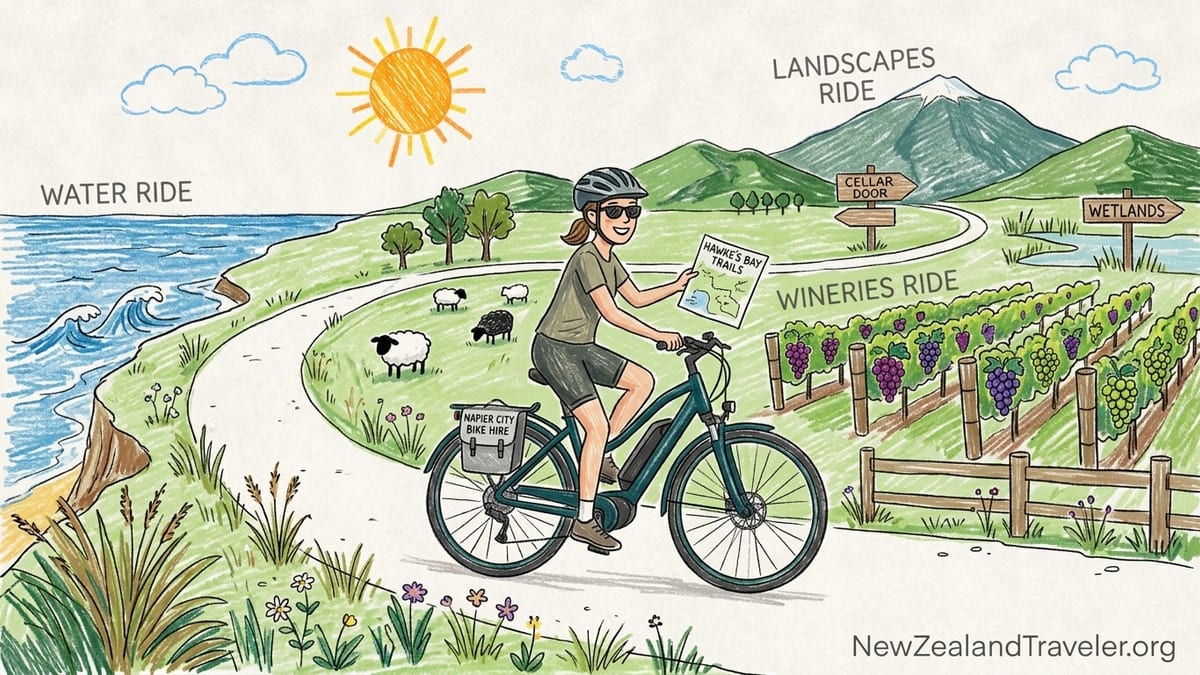
For my first full day linking coast, river, and wineries, I rode a step-through pedal-assist e-bike hired from Napier City Bike Hire & Tours. Their fleet includes Sinch and Merida e-bikes with Shimano pedal assist, multiple sizes, and practical touring touches like hydraulic disc brakes and a suspension fork. I chose the step-through frame specifically because Hawke’s Bay wine-country cycling involves lots of stopping, restarting, and awkward dismounts outside cellar doors. A step-through keeps that graceful, low-effort rhythm.
I hired the e-bike for a full day (9 a.m. to 5 p.m.), and what surprised me most wasn’t speed, it was how relaxed I stayed. Hawke’s Bay can feel breezy and wide-open along the coast and exposed river sections. On an e-bike, headwinds became background noise rather than the defining feature of the day. The assist also helped after tastings, when you’re still steady and responsible, but your motivation for grinding into wind is understandably lower.
Saddle comfort matters more on these trails than people admit. My hire included a gel seat cover, and I used it from the start. On Hawke’s Bay’s firm limestone paths, the micro-vibration can creep up over 20 to 35 km. The gel layer didn’t turn the saddle into a sofa, but it took the sting out of corrugations and made the late-afternoon kilometers feel the same as the morning.
Could you do my routes on a normal bike? Absolutely, especially if you cycle regularly. But the e-bike bought me time. More time to linger over lunch, to say yes to a spontaneous tasting, and to roll into the final winery stop without checking my watch every five minutes. For most travelers who are here for wine-country pacing rather than training, that is the real value.
Hiring, Fitting, And The Real-World Logistics (Locks, Bags, And Wine)
I booked in advance for peace of mind, but the handover still felt quick and human. The shop set my saddle height, ran through controls, and handed over the practical kit that makes a wine-country day work: helmet, lock with a personal combination, and a small pannier or bar bag depending on bike type. That lock matters. You will lock up constantly: outside cellar doors, cafés, toilets, lookouts, and anywhere you step away to take a photo.
If you’re planning to buy bottles during the day, think about weight and carrying capacity before you start. A compact pannier is fine for a light jacket, phone charger, and a couple of small purchases, but wine adds up fast. On my riding days, I kept purchases modest and prioritized tasting over collecting. If your goal is shopping, consider an operator that offers wine collection or a shuttle solution, so you are not riding with a clinking, top-heavy load late in the day.
For a different style of day that stays squarely inside the wine districts, operators like On Yer Bike Winery Tours base you right in the middle of the action around Roys Hill, close to the Gimblett Gravels and Bridge Pā areas. Their model is self-guided, but they handle the day’s structure: route briefing, bikes, and a simple “buy wine before mid-afternoon and we’ll collect it” approach that removes the biggest annoyance of biking between cellar doors.
Another practical option if you want a very relaxed, upright ride is Coastal Wine Cycles, which rents beach-cruiser style bikes from Haumoana. The cruiser geometry makes short hops between coastal villages and nearby wineries feel more like a holiday than a workout. It is not the bike I would pick for long mileage or windy slogs, but for an easy coastal wine day, that comfort-first approach makes sense.
Trail Surfaces, Junctions, And What “Mostly Off-Road Limestone” Feels Like
Hawke’s Bay Trails is frequently described as mostly off-road limestone, and that description is accurate in the way travelers care about: you spend long stretches away from fast traffic, on wide paths that feel forgiving and social. Under the tires, limestone is generally firm and smooth, but it is still a compacted gravel surface. After a few kilometers, you notice a dry, pale dust on your shoes and lower legs, especially in warmer conditions. I wore sunglasses even when it was not bright, simply to keep wind and grit out of my eyes.
Junctions are where a “Grade 1 easy” ride can briefly demand attention. The network is designed as themed rides, but on the ground it is a web of river paths, stopbanks, underpasses, and link trails. I found it easiest to think in segments: coast segment, river segment, vineyard segment, then use the map for the transitions. When you roll into a junction at cruising speed, it helps to slow down early, because the most scenic option is not always the most obvious one.
Wind is the invisible surface. Along the coastline and open estuary areas, it can push you sideways and make you drift on the path even when the gravel is perfect. I kept my hands light on the bars, stayed seated, and let the bike move slightly rather than fighting every gust. On an e-bike, the assist can tempt you to overcorrect and speed up into wind; I preferred to dial assistance down and keep a steady cadence.
One important operational note for late 2026: Hawke’s Bay Regional Council has advised a cycle trail closure along the Brookfields Lower stopbank due to flood resilience upgrade works. Enabling works were scheduled to start Monday 21 September 2026, with main construction expected from October 2026 to around April 2027, and a detour planned during the closure. If your route uses that stopbank corridor near the Tūtaekurī River, build in extra time for detours and check the most current trail status right before you ride.
The Wineries Ride: The Easiest “Wine Country Loop” I’ve Ridden
I rode the Wineries Ride as a deliberately unhurried day, treating it like a moving progressive lunch: ride a short section, taste, snack, ride again. Official visitor information describes a mostly flat loop and notes that the Wineries Ride currently links 10 cellar doors. In practice, that means you can keep your riding legs fresh because the next stop is never far away, and your most difficult decision becomes whether to have lunch early or late.
On the trail, the vibe is farmland and vines rather than dramatic coastline. The riding is mellow: straight stretches where you can chat side by side, gentle curves, and the occasional moment where you pop onto a short on-road link before slipping back onto limestone. This is where a standard hybrid feels completely appropriate. If you do not care about maximizing stops, a normal bike is enough. If you want to fit in tastings without feeling rushed, the e-bike helps you bank time.
My personal rhythm was two tastings, then food, then one more tasting. Riding after tastings felt exactly how you want it to feel: relaxed, alert, and a little dreamy, provided you keep it responsible. I kept tastings small, drank water at each stop, and slowed my pace rather than chasing distance. On these flat trails, the danger is not a hard descent, it is complacency. A steady, upright posture and conservative speed felt like the right “wine-country” riding style.
If you want a version of the Wineries Ride with support built in, there are self-guided packages that include shuttles and detailed route notes from Napier-based operators. That approach is particularly useful if your accommodation is in central Napier and you do not want to think about how you will get back after a long, taste-heavy day.
Landscapes Ride: Where The Trail Stops Being Just A Trail
The Landscapes Ride is where Hawke’s Bay’s cycling network shows off its range. This is the route family that stitches together rivers, rural backroads, coastal edges, and those wide, luminous Hawke’s Bay skies. I experienced it as a “big day” feel without big physical difficulty: you cover ground, watch the scenery change, and start understanding how the region fits together beyond cellar doors.
What I liked most was the way small towns and trailheads give you natural reset points. You can top up water, grab a coffee, or simply pause and look at the landscape without feeling like you are blocking anyone. If you’re traveling with mixed abilities, Landscapes is the best “choose shorter or longer” option: you can ride an easy section and still feel you saw something quintessentially Hawke’s Bay.
This is also where wind can be most noticeable. Between open farmland and river corridors, you can have a tailwind that makes you feel like a hero on the way out, then the same wind becomes a headwind on the way home. If you are riding a standard bike and you are not a frequent cyclist, plan your day so you have a café or winery stop available when motivation drops. On an e-bike, it becomes less of a morale issue, but you still feel it in your posture and steering.
Researched note: there are operators who explicitly offer shuttles to get riders onto the Landscapes Ride and back again, and some hire businesses can arrange accommodation pick-ups. If you want the scenery without the out-and-back effort, that shuttle-supported approach is a smart way to experience a longer-feeling ride in a half-day window.
Water Ride: Coastal Concrete, Wetlands, And A Different Kind Of Wine Add-On
The Water Ride felt like the easiest “city-to-nature” loop I did in Hawke’s Bay. It starts with that satisfying shoreline cycling where the surface is smooth and confidence-inspiring, then it drifts inland into wetlands that feel quiet and unexpectedly wild. Compared with the vineyard routes, the Water Ride is less about tasting and more about moving through environments, from sea edge to lagoon-like wetlands and back to cafés.
Surface-wise, it is a mix: sections of concrete path near the coast and smoother shared paths, then limestone and quieter trail corridors as you move around wetland areas. If you are traveling with kids or anyone nervous about gravel, this is where a standard bike with stable tires shines, because much of the ride feels “path-like” rather than “trail-like.” It is also a good confidence builder before you commit to longer vineyard rides.
The Water Ride pairs well with a single winery objective rather than a crawl. You can do the loop, then tack on a focused tasting plan such as Mission Estate and Church Road near Taradale if time and energy line up. That combination is especially good for travelers who want to experience Hawke’s Bay wine history but do not want an all-day cellar door marathon.
One detail I appreciated: because the Water Ride is so close to Napier’s services, it is the easiest day to keep simple. You can carry less, refill water more often, and finish with a meal without needing a shuttle or car. If you are in Hawke’s Bay without a vehicle, this route is the most straightforward way to still feel like you “got out there.”
Food, Water, Luggage, And The Reality Of Riding After Tastings
The best practical habit I picked up in Hawke’s Bay was treating water as part of the tasting ritual. I drank water at every stop, not just when I felt thirsty. Many cellar doors are happy to provide water, and I still carried my own bottle so I was never relying on timing or staffing. On warm, dry days, the limestone reflects light and heat; dehydration can sneak in even when the ride feels easy.
Food planning mattered because cellar doors can be seasonal with hours and kitchen days, and you do not want to be the cyclist eating a packet snack in a carpark at 3 p.m. I aimed for one proper sit-down meal and one lighter snack stop. When I got it right, the day felt smooth: ride, taste, eat, ride. When I got it wrong, the last third of the ride felt longer than it needed to.
Luggage strategy is simple: keep weight low, keep it stable, and assume you will stop often. I preferred a small pannier or bag over a backpack for comfort and sweat management. A backpack is fine for an hour; for a full wine day, it makes you feel sticky and slightly impatient. If you are bringing extra layers, pack a thin windproof shell rather than a bulky jacket, because wind changes quickly near the coast and rivers.
Riding after tastings should feel calm, not edgy. I kept to conservative speeds, avoided sudden maneuvers, and took a moment before leaving each winery to re-center: helmet strap secure, phone put away, map checked, and a sip of water. If you feel even slightly wobbly, it is time to stop tasting and switch to food and coffee. Hawke’s Bay makes that easy because the network is built around places to pause.
The Takeaway
If you want the simplest, most enjoyable version of Hawke’s Bay Trails, match the bike to the type of traveler you are, not the type you wish you were. A standard hybrid or cruiser is perfect for confident riders doing short loops, especially on the Wineries Ride where distances between stops are modest. An e-bike makes the day feel unhurried, handles wind and “one more winery” optimism, and keeps energy in reserve for food and scenery. A guided tour makes sense if you want local storytelling, fixed timing, and zero navigation stress. A self-guided hire with shuttle support is the sweet spot for many travelers: independent pace, plus an easier start and finish.
My own best Hawke’s Bay day blended easy riding with deliberate stops. I rode electric, used the gel seat cover, carried minimal luggage, and planned my tastings around a real meal. That combination let me experience three distinct personalities of the region: the Wineries Ride’s effortless cellar door hopping, the Landscapes Ride’s changing scenery, and the Water Ride’s coast-and-wetlands calm. The trails gave me the structure. The wine country gave me the reward.
FAQ
Q1. Is Hawke’s Bay Trails suitable for beginner cyclists?
Yes. Much of the network is flat and designed for easy day rides, with wide paths and plenty of places to stop for breaks.
Q2. Should I hire a normal bike or an e-bike for the Wineries Ride?
A normal bike works well for regular cyclists and shorter tasting days. An e-bike is better if you want extra time for winery stops, if wind is up, or if your group has mixed fitness.
Q3. How long is the Wineries Ride and how many cellar doors does it link?
Route length varies depending on start point and detours, but it is commonly described as a roughly 30 km loop. Current official visitor information says the Wineries Ride links 10 cellar doors.
Q4. What are typical e-bike hire prices in Napier?
Napier City Bike Hire & Tours lists e-bike hire at NZ$100 for a day (9 a.m. to 5 p.m.), with shorter and multi-day options also available.
Q5. Are there self-guided winery bike tours with shuttles?
Yes. Some operators sell self-guided packages that include bike hire plus a return shuttle, which is useful if you don’t want to plan transport back to Napier.
Q6. Are there any known trail closures to consider in late 2026?
Yes. Hawke’s Bay Regional Council has advised a closure of the stopbank cycle trail during the Brookfields Lower stopbank upgrade works, with detours planned. Check current status right before riding.
Q7. What should I carry on a Hawke’s Bay wine-country ride?
Carry a water bottle, light wind layer, sunglasses, sunscreen, a phone charger if you’re navigating, and enough space for small purchases. Avoid overloading yourself with heavy wine bottles.
Q8. What does “mostly off-road limestone trail” feel like under the tires?
It generally feels firm and smooth, like compacted gravel. You may notice light vibration and dust in dry conditions, so comfort touches like wider tires or a gel seat cover help.
Q9. Is it safe to ride after wine tastings?
It can be, if you keep tastings modest, drink water, eat food, and ride conservatively. If you feel impaired, stop tasting and use a shuttle or other transport option.
Q10. Which ride should I choose: Water, Landscapes, or Wineries?
Choose Water for an easy coast-and-wetlands loop close to Napier, Landscapes for bigger scenery changes and flexible day sections, and Wineries for the most direct cellar door-to-cellar door experience.