


I didn’t fall for Hawke’s Bay because it had “so many things to do.” I fell for it because the best experiences here are specific, tactile, and easy to stitch into a trip without overplanning: a city rebuilt in a single architectural mood, a wine region you can taste by the glass, a summit you can still drive to, limestone cycle trails that link real lunch stops, and a seabird colony that feels like an IMAX screen with wind and salt on your face. What follows isn’t a checklist. It’s the set of choices that defined my days, plus the practical, real-world details I wish I’d known before I arrived.
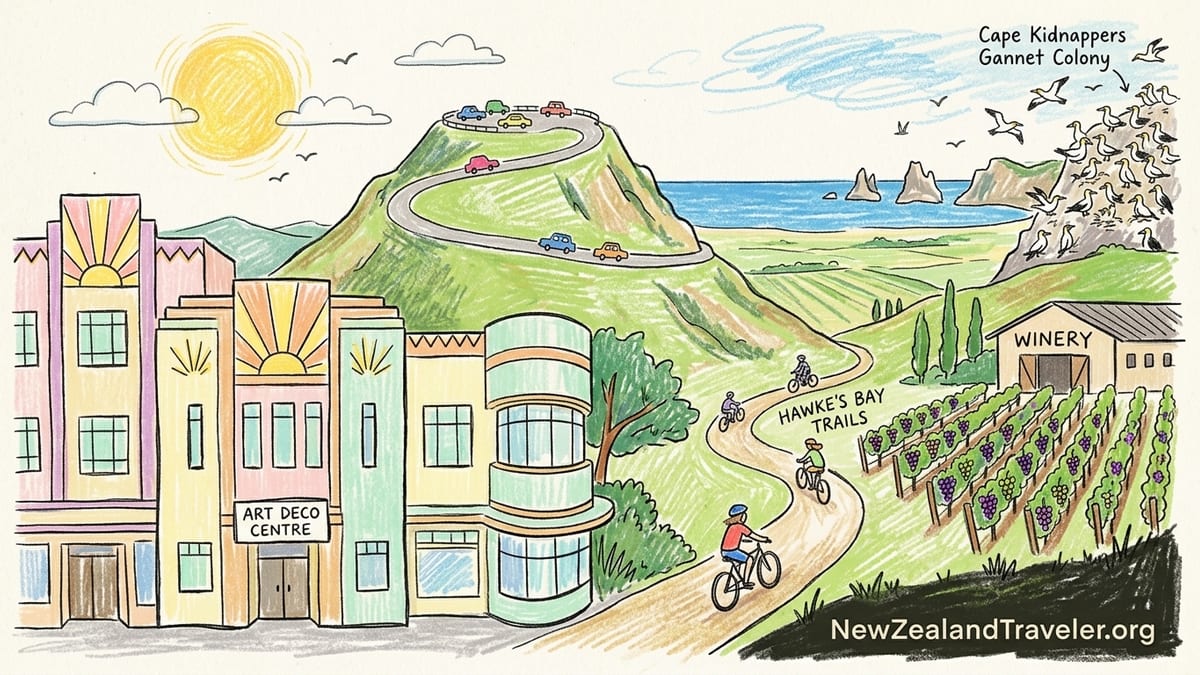
Napier Art Deco: The Walk That Made The Buildings Click
My Napier “aha” moment didn’t happen when I first spotted a zigzag facade. It happened inside the Art Deco Centre at Memorial Square, where the Art Deco Trust starts its guided walks with a short film before you even step outside. That small reset matters, because once you hear the 1931 earthquake story and the logic of the rebuild, the streets stop feeling like a pretty backdrop and start reading like a deliberate, city-scale design project.
I booked the morning walk and paid from NZ$33 per person, and the real time commitment was closer to 90 minutes once you include showing up a little early, settling in for the film, and then walking at a pace that allows the guide to point out details above eye level. The route felt flat and accessible, and my group size landed in that sweet spot where you can hear the guide without feeling like you’re in a school excursion. It wasn’t empty, but it also wasn’t elbow-to-elbow, more like a steady trickle of travelers who had made the same smart decision to start here rather than freewheeling around with a phone.
What I actually saw, up close, were the things I would have missed on my own: sunbursts above doorways, curved corner windows that catch reflections like lenses, and the way pastel paint schemes make even everyday streets feel crisp in Hawke’s Bay light. The unexpectedly good part was how much of the tour was about people, not just geometry. The only piece that felt slightly overrated was the impulse to “photograph everything.” After ten minutes my camera roll was a blur of details, and the better move was to take fewer photos and listen for the story behind the most distinctive facades.
Winery Cellar Doors: How I Built A Tasting Day Without Overdoing It
In Hawke’s Bay, the cellar door culture is the trip. The easiest mistake is trying to hit too many wineries in one day, which turns tasting into logistics. I kept it to a tight loop and treated each stop like an hour-long chapter with a clear purpose: one for a structured, premium-leaning tasting, one for a classic heritage setting, and one where I could slow down and snack.
At Craggy Range, the cellar door runs timed experiences and booking matters. I chose their standard Wine Experience, which is priced at NZ$50 per person and takes about 60 minutes in real time, including the settling-in at your table. It’s not a casual “stand at the bar and sip” stop. It felt more like a guided mini class, and the setting under Te Mata Peak made it feel anchored to place, not just product. The surprise was how much I appreciated the pacing. Five wines plus a flagship pour sounds like a lot, but a seated format and a guide keeping the tempo made it feel focused rather than boozy. If you want the most immersive option, they also list a longer Giants Estate Experience at NZ$175 per person, but for my trip the one-hour option was the right match.
For a second stop with a very different energy, I went to Mission Estate’s cellar door in Taradale and booked their Premium Hosted Tasting at NZ$20 per person. The tasting itself is designed to run roughly 30 to 40 minutes, and that’s close to what I experienced once you factor in waiting a moment for your host and then moving through the wines at a comfortable pace. What I noticed most here wasn’t a single “wow” sip, but the way the experience leans into heritage: you’re tasting inside a place that wants you to look up from the glass and take in the setting. It was also the stop where I felt the strongest “don’t rush” impulse. Even if you’re not doing lunch, give yourself time to walk the grounds.
My third tasting leaned more casual: Black Barn, which offers a guided tasting of five estate wines for NZ$30 per person, or a self-guided flight of four wines for NZ$20. I opted for the guided version because I wanted someone to help connect the dots between what I’d tasted earlier in the day. Black Barn’s cellar door hours are listed as 11 a.m. to 4 p.m., seven days a week, and that midday-to-afternoon window shaped my day: I started earlier at Craggy Range, then slotted Black Barn as a later stop when I wanted a slower, warmer, end-of-day feel. The only part I’d call overrated is the idea that you need to buy bottles to validate the tasting. Buy what you genuinely loved, but don’t let cellar-door pressure steer your suitcase.
Te Mata Peak: The Approach, The Parking, The Walk, The View
Te Mata Peak isn’t a “maybe.” It is the landmark that tells you where you are. Officially, the peak rises to 399 metres above the Heretaunga Plains, and the practical magic is that it still offers a drivable route to the summit, plus walking and mountain-bike tracks for people who want to earn the view. I did both the drive and a short walk, because the drive delivers the big panorama quickly, and the walking delivers the intimacy, the wind, and the smell of dry grass that makes the place feel alive.
My approach started from Havelock North, following the usual lead-in toward Te Mata Park and then up Te Mata Peak Road. The drive gets narrower as you climb, with lookout pull-ins that tempt you to stop early. I resisted until the top because the summit viewpoint is the payoff. Parking at the summit area felt like a shared resource: cars cycling in and out, people pausing for photos, runners popping out of trails. It wasn’t chaotic on my visit, but it also wasn’t empty. Expect a steady rotation rather than solitude, especially around classic photo times.
Once parked, I walked beyond the immediate carpark viewpoints to give myself a clearer sense of scale. The view is the kind that makes you say directions out loud: vineyards and shelterbelts laid out like a grid, the wide plains, and then the coast in the distance when the air is clear. What surprised me was how much the wind changed the experience. At the summit, it didn’t feel like a gentle breeze, it felt like something you lean into, which made the view feel earned even though I drove.
The single most important practical detail to know is an official rule that impacts sunrise, stargazing, and late-night drives: the upper section of Te Mata Peak Road above the Peak House is closed to vehicles overnight from 10 p.m. to 5:30 a.m., every day. That means you can still plan for golden hour and sunset, but if you’re imagining a midnight summit drive, you’ll need a different plan. For me, that closure actually improved the experience because it nudged my visit into daylight hours when the plains read like a living map.
Hawke’s Bay Trails: The Ride That Turned A Wine Region Into A Day Out
I didn’t come to Hawke’s Bay thinking I’d spend a meaningful part of my trip on a bike, but the Hawke’s Bay Trails changed that. This is a nearly 200-kilometre network of cycling and walking trails spread across Hastings District and Napier City. It’s also positioned as one of New Zealand’s Great Rides, and the most useful detail for travelers is that the surfaces are designed for reliability: mostly off-road limestone that holds up in a range of conditions.
The way it actually worked for me was simple: the trails let me connect experiences without the mental load of driving, parking, and re-parking. When you’re pedaling, Hawke’s Bay feels stitched together. You roll from quiet river edges into town edges, then out again into open space. Instead of “going to” a winery, you arrive at it gradually, with the landscape changing in your peripheral vision.
Time-wise, a “quick ride” here can still become half a day once you factor in stopping. That’s not a warning, it’s the point. I built my ride around long pauses: a photo stop where the light hit the river at an angle, a shaded bench break, and a lunch plan that didn’t require rushing. Crowds on the trail sections I rode felt dispersed. I saw other riders, but not in dense packs. It felt like local infrastructure, not a tourist funnel.
If you want to replicate my best decision, it’s this: use the trails as a framework for food. The region calls itself Food and Wine Country for a reason, and the trails deliver you to places where you can legitimately reward yourself. The only part that felt slightly overrated was trying to treat the network like a single “must-do route.” It’s better to choose one comfortable segment, do it slowly, then spend your energy on what’s at the other end.
Cape Kidnappers Gannets: The Wildest Three Hours Of My Trip
Cape Kidnappers delivered the most vivid wildlife memory of my time in Hawke’s Bay. I went with an overland operator rather than attempting to improvise access, because the experience is built around being transported across station land to the gannet colony viewpoint. I booked a regular tour with Gannet Safaris, which lists adult tickets at NZ$99 and a duration of about three hours. They operate seasonally, open from 1 August to 30 April, with daily departures listed at 9 a.m. and 1:30 p.m., and that schedule shaped my planning more than anything else.
The ride itself is not a forgettable shuttle. It’s part of the show: traversing riverbeds, rolling pasture, and steep gullies, with frequent moments where you look out and realize the “view” is 360 degrees, not a single direction. What I felt most strongly on the drive was distance. You start near the coast and then keep going until the coastline feels like a ledge at the edge of the world.
At the colony, what I saw and heard was constant motion: birds launching, landing, settling, and rearranging in a way that looks chaotic until you watch long enough to see it’s patterned. The smell is real and unmistakable, the kind of pungent seabird presence that tells you you’re not in a curated zoo environment. Crowds were present but controlled by the tour format. I didn’t feel packed in, but I did feel like you want to be ready with your camera because you’re sharing time in a fixed place, and the best moments happen quickly.
The overrated expectation is thinking this will feel serene. It’s not serene. It’s loud, windy, and alive. The unexpectedly good part was how the journey made the destination feel earned. I left with that slightly salt-sticky feeling you get after being out in real weather, and it was my clearest reminder that Hawke’s Bay isn’t just wine country, it’s also a working coastline with genuine wildness.
Sunday Farmers’ Market And Food: The Tastes That Became My Souvenirs
If you only do one “food experience” in Hawke’s Bay, make it the Hawke’s Bay Farmers’ Market. It’s open every Sunday from 8:30 a.m. to 12:30 p.m., rain, hail, or shine, and it runs at Waikoko Gardens at the Tomoana Showgrounds. I arrived hungry and left with the kind of bag that turns your accommodation into a picnic base: something sweet for now, something savory for later, and a couple of items that made me feel like I could recreate the trip at home.
What I actually experienced was a market with practical traveler comforts. There are ATMs on site, and parking is part of the setup, including paddock parking that handles the Sunday influx. The crowd level felt like a gentle surge. Early on, it was easy to move and browse; later, it tightened into slow walking lanes where you start making small negotiations with your shoulders and shopping bag.
Because I’m not going to invent your perfect bite, I’ll describe the pattern that worked best for me: eat immediately, then shop. I made the mistake of shopping first, which meant I carried food while trying to keep it intact, and I watched other people doing it smarter, grabbing breakfast right away and lingering with coffee while the market warmed up. My most satisfying “souvenir” was not a trinket from a gift shop, it was the decision to build my day around what I could taste right then, in the open air, with everyone else doing the same.
If anything here can feel overrated, it’s the impulse to do the market quickly, like it’s an errand. Give it a real morning. The unexpectedly good part was how it reset my palate after tasting rooms. Wine tastings can start to blur together. The market snapped everything back into focus, because the food is immediate and specific, and it tastes like a region with enough sun to make produce feel like it has volume.
The Takeaway
Hawke’s Bay worked for me because the signature experiences aren’t abstract. They’re built around real, do-able blocks of time: 90 minutes of Art Deco context that makes a whole city legible, one-hour cellar door tastings that don’t hijack your day, a peak you can drive for a quick panorama or walk for texture, trails that turn transport into part of the vacation, and a gannet colony that feels like pure, unscripted nature.
If I were planning the same trip again, I’d keep the same structure and just refine the pacing: start in Napier with the guided Art Deco walk, commit to two or three cellar doors rather than five, hit Te Mata Peak with daylight for maximum clarity, reserve one half-day for the Hawke’s Bay Trails and treat it as a food-linked adventure, and lock in Cape Kidnappers early in the trip so weather changes don’t steal it. Then I’d end on Sunday morning at the farmers’ market, when Hawke’s Bay tastes like it’s waking up.
FAQ
Q1. How long does the official Napier Art Deco guided walk really take?
Plan for about 90 minutes door-to-door, because it includes a short film plus the guided walk, and you should arrive a little early.
Q2. How much does the Art Deco Trust walking tour cost right now?
Prices are listed from NZ$33 per person for the guided walk, with other time slots priced slightly differently depending on the season and format.
Q3. Can you drive to the top of Te Mata Peak?
Yes. Te Mata Peak remains drivable to the summit, with parking at the top and short walking options for viewpoints.
Q4. What is Te Mata Peak’s official height?
Te Mata Peak rises to 399 metres above the Heretaunga Plains.
Q5. Is Te Mata Peak Road open all night?
No. The upper section of Te Mata Peak Road above the Peak House is closed to vehicles overnight from 10 p.m. to 5:30 a.m. every day.
Q6. What are the Hawke’s Bay Trails, in plain terms?
They are a nearly 200-kilometre network of mostly off-road cycling and walking trails across Napier and Hastings that link towns, rivers, wineries, and food stops.
Q7. How much does a Cape Kidnappers gannet tour cost and how long is it?
Gannet Safaris lists regular adult tours at NZ$99 with a duration of about three hours, operating seasonally from 1 August to 30 April.
Q8. What are the current opening hours for Hawke’s Bay Farmers’ Market?
It runs every Sunday from 8:30 a.m. to 12:30 p.m., rain, hail, or shine, at the Tomoana Showgrounds in Hastings.
Q9. Do you need to book cellar-door tastings in Hawke’s Bay?
For structured, timed experiences like Craggy Range, bookings are required and time slots are set. Other cellar doors may allow walk-ins, but weekends can fill quickly.
Q10. If I only have one day in Hawke’s Bay, what’s the best mix?
Do the Art Deco guided walk in Napier in the morning, choose two cellar doors with pre-booked tasting times, and finish at Te Mata Peak for late-afternoon views.