


Auckland is often treated as a necessary gateway to New Zealand’s mountains and road trips, a place to crash after a long-haul flight before heading for Queenstown, Rotorua or the South Island. That is a mistake. The country’s largest city rewards anyone who gives it two to four days, from volcanic cones and harbourside neighbourhoods to island wineries just a ferry ride from downtown. This guide focuses on first-time visitors basing themselves around the central city and nearby districts, and on how to use Auckland as more than just an arrival airport.
Arriving at Auckland Airport and Reaching the City
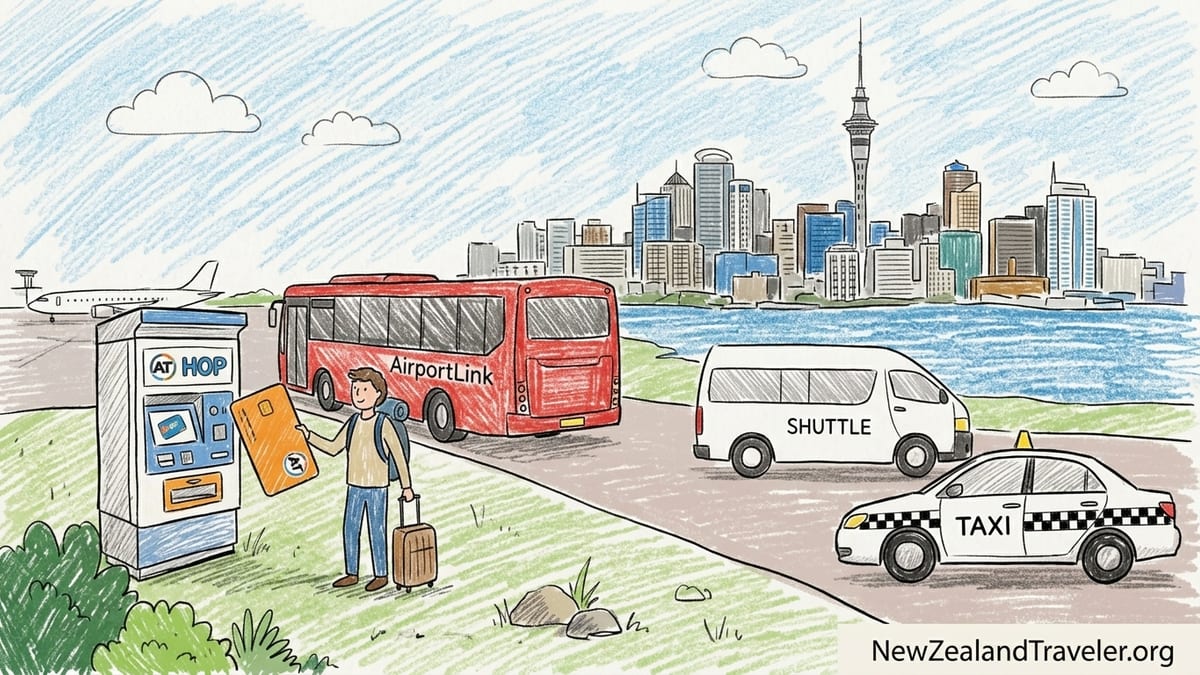
Auckland Airport sits about 20 kilometres south of the city centre. After clearing biosecurity and customs, you enter an arrivals hall that feels busy but manageable, with AT HOP public transport card machines, currency exchange booths and phone shops lined up near the exits. For most first-time visitors, the question is whether to head into the city by public transport or a direct transfer. Your choice will depend on budget, luggage and how tired you feel after the flight.
The cheapest public option uses the orange AirportLink bus to nearby Puhinui train station, then a suburban train into the city. Recent visitors typically pay under 10 New Zealand dollars one way using an AT HOP card across both legs, compared with a higher walk-up fare if paying by contactless bank card or buying individual tickets. Trains from Puhinui generally run at least every 20 minutes during the day and stop at Britomart Transport Centre in the CBD, a short walk from most downtown hotels. Allow roughly 45 to 60 minutes door to door into central Auckland, including the transfer.
If you want a direct ride without managing luggage on and off buses and trains, airport express buses and shared shuttles are the main alternatives. Express buses run between the airport and central Auckland, often terminating around SkyCity near the base of the Sky Tower, with an adult fare commonly around 20 dollars one way. Shared shuttle vans are plentiful in the taxi ranks and charge per passenger to city hotels. They can be cost effective for solo travellers, but may detour to drop other passengers. Standard taxis and app-based rides are easy to find outside both domestic and international terminals and suit couples or small groups splitting the fare, especially late at night.
Whatever you choose, pick up an AT HOP card if you plan to use public transport beyond a single airport trip. Machines in the arrivals area usually sell the card preloaded with credit for around 25 dollars, and you can top up at stations, ferry terminals and convenience stores across town. The card gives you cheaper fares on buses, trains and most commuter ferries, and is the easiest way to keep local transport costs predictable during a short stay.
Understanding Auckland’s Layout: Beyond a Simple CBD Stopover
Central Auckland hugs the edge of the Waitematā Harbour. For a first-time visit, think of the city as a set of overlapping hubs: the CBD and Britomart around the main downtown train and ferry terminals; the Viaduct Harbour and Wynyard Quarter waterfront; inner suburbs like Ponsonby and Mount Eden; and the North Shore village of Devonport and the inner gulf islands of Waiheke and Rangitoto. Most first-time visitors can cover these with a mix of walking, public transport and short ferry rides.
Britomart is the practical heart of the network, combining a train station and major bus stops with the Downtown Ferry Terminal just across Quay Street. From here you can step straight onto ferries for Devonport, Waiheke and Rangitoto, or buses up Queen Street and into the suburbs. A typical first morning in Auckland might involve walking from a hotel near the Sky Tower down to Britomart, grabbing a coffee from one of the laneway cafés, then boarding a ferry to Devonport for harbour views before lunchtime.
The key to enjoying Auckland is to allow enough time for these different areas instead of treating the CBD as the only attraction. The best itineraries give at least one full day to the city centre and nearby volcanic viewpoints, another day to the harbour and waterfront neighbourhoods, and a separate day to one of the islands. This is why many first-time visitors now plan a minimum of two nights, with three or four nights ideal if you want to travel at an easy pace or factor in wet weather.
Distances within the central area are walkable but hilly. Mount Eden, for example, sits only about 4 kilometres from the CBD, yet the walk involves both suburban streets and a short climb up the cone. Ponsonby Road, a popular dining and nightlife strip, is less than 30 minutes on foot from the Sky Tower but involves steady uphill stretches. Factor in the terrain and the likely jet lag when planning how much to tackle on your first day.
CBD, Sky Tower and Neighbourhoods: Where to Stay and Explore
For a first-time visit, the central business district provides the simplest base. Hotels clustered around Queen Street, the Sky Tower and Britomart put you within a 10 to 15 minute walk of the main train hub, ferry terminal and most airport bus stops. International chains sit alongside locally run boutique hotels and serviced apartments. A typical mid-range room within walking distance of Britomart often falls in the 200 to 300 dollar per night range outside major events, with budget-friendly hostels and simple hotels cheaper but sometimes noisier along lower Queen Street.
Staying near the Sky Tower places you in the thick of the city’s entertainment district, with casino floors, restaurants and views from the observation deck. On a clear evening, riding the high-speed elevators to the observation level offers a first panoramic orientation of Auckland’s geography: the twin harbours, Rangitoto Island rising from the water, and volcanic cones scattered through the suburbs. Time your visit for late afternoon to watch the light change, then wander a few blocks to Federal Street or nearby laneways for dinner.
Britomart itself has transformed from a purely transport node into a stylish neighbourhood of repurposed brick warehouses, boutique fashion stores and small bars. Visitors who prefer a walkable, design-focused stay may choose a boutique hotel in this area, waking up to flat white coffees, local bakeries and an easy stroll to morning ferries. The small streets between Britomart and the waterfront feel particularly lively on Friday evenings as office workers spill out to after-work drinks.
If you want a slightly more residential feel while remaining close to downtown, Ponsonby is a strong candidate. A short bus ride or rideshare from the CBD, Ponsonby Road is lined with villa-style houses, design stores, bars and some of Auckland’s best restaurants. Self-catering apartments and guesthouses are common here, and a typical evening might see you wandering between wine bars, casual burger joints and more polished bistros. It can be a smart base for travellers who want nightlife and dining on their doorstep but prefer to sleep away from the CBD’s late-night noise.
Waterfront Auckland: Viaduct Harbour and Wynyard Quarter
Auckland’s relationship with the water is most obvious along the chain of wharves that stretch west from the Ferry Terminal. Viaduct Harbour, once a working commercial port, is now lined with restaurants, bars and hotel terraces. On summer evenings, tables fill with office workers and visitors watching yachts return from the harbour and superyachts moored in the marina. Even if you are not planning a big meal, strolling the piers at sunset gives a sense of how closely Auckland life is tied to the water.
Immediately beyond the Viaduct, Wynyard Quarter has become one of the city’s most pleasant places for a slow afternoon. Apartment blocks and office towers sit alongside wide promenades, children’s playgrounds, public art and a mix of casual eateries. Food trucks and outdoor seating appear on fine weekends, and the pedestrian drawbridge that links back to the Viaduct opens for passing boats, creating regular photo opportunities. Travellers with children often base themselves near Wynyard for the easy access to green space and car-free walking, while still being less than 20 minutes on foot from Britomart.
Many harbour cruises, whale and dolphin watching trips and sunset sailing excursions depart from berths along the Viaduct and nearby piers. If your Auckland stay is short, a two to three hour evening harbour cruise can be an efficient way to combine sightseeing with dinner or drinks, though you will pay more than you would for a simple public ferry ride. On tighter budgets, the standard commuter ferry to Devonport offers harbour and skyline views for a fraction of the price.
Wynyard Quarter is also a good example of how quickly Auckland’s waterfront is evolving. Construction cranes are common, and what is a quiet street one year might host a new restaurant precinct the next. It is worth walking the area rather than relying only on older guidebook descriptions, and being prepared to detour around active building sites as the neighbourhood continues to grow.
Volcanic Auckland: Mount Eden and the Auckland Museum
Auckland sits atop a volcanic field of dozens of cones and craters, many of them easily accessible from the city centre. For first-time visitors without a rental car, Mount Eden is the best introduction. The suburb lies a short train or bus ride from Britomart, and from the base it is a 10 to 20 minute walk up a paved path to the summit. The grassy crater itself is off-limits to protect the landscape, but a ring of lookout points offers broad views across the CBD to the harbour and out to Rangitoto Island.
Time your Mount Eden visit for clear conditions, ideally in the morning or late afternoon when the light is softer. On busy summer weekends you may share the summit with tour groups and runners, but there is usually enough space to find a quiet spot. Wear sturdy shoes even though the path is paved, as it can be slippery after rain. Many visitors choose to buy a takeaway coffee on Mount Eden Road and carry it up, turning the climb into a relaxed walk rather than a workout.
The Auckland War Memorial Museum, generally shortened to Auckland Museum, provides historical and cultural context for what you see from the cones and along the waterfront. Housed in a neoclassical building on a rise in the Auckland Domain park, it is a short bus ride or about 25 minutes on foot from the CBD. Exhibitions cover natural history, Māori taonga (treasures), Pacific cultures and New Zealand’s involvement in global conflicts. It is an especially good choice for a rainy afternoon or the first day of a trip while you recover from jet lag.
Admission policies change from time to time, but international visitors can expect to pay a modest entry fee, with discounts for children and seniors. Plan at least two hours if you want to see the key galleries without rushing. Afterwards, walk through the surrounding Domain, where locals jog the loop roads and families picnic on the lawns. From certain points you can also look back towards the Sky Tower and out across the harbour, reinforcing how closely nature and city life intertwine here.
Harbour Islands: Devonport, Waiheke and Rangitoto
The easiest way to grasp that Auckland is more than just a downtown skyline is to board a ferry from the Downtown Ferry Terminal. Frequent services to Devonport cross the harbour in around 12 minutes, making it an ideal half-day escape. When you step off the boat you enter a compact village of Victorian villas, cafés, bookshops and art galleries. Climb nearby North Head or Mount Victoria for classic skyline and harbour views, then reward yourself with fish and chips on the beach or coffee on the main street before returning to the city.
For many visitors, Waiheke Island is the standout day trip. Ferries usually take about 40 minutes to reach Matiatia wharf, with some sailings detouring via Devonport. Once on the island, local buses and small shuttle vans fan out to beaches and vineyards. A common first-time itinerary might include a late-morning ferry, lunch at a vineyard restaurant overlooking rows of vines and the sea, a swim at a sheltered beach like Oneroa, and a late-afternoon sailing back to the city in time for dinner around Britomart. Return ferry fares can be significant compared with city transport prices, so it is worth checking current costs and schedules as you plan.
Rangitoto Island offers a different experience again. This volcanic island, easily visible from the city as a low, symmetrical cone, is largely uninhabited and covered in lava fields and native bush. Ferries take around 25 minutes from the city, and you must bring all your food and water, as there are no shops on the island. The main activity is the walk from the wharf to the summit, which usually takes 45 minutes to an hour each way on a well-formed track. From the top, you enjoy sweeping views back to the Auckland skyline and across the Hauraki Gulf.
Because Rangitoto is more rugged than Devonport or Waiheke, it requires a little extra planning. Ferries operate a limited timetable, and you need to be confident you can return to the wharf in time for the last boat back to the city. In summer, combine good sun protection with sturdy footwear, as the dark lava rocks hold heat. Those who prefer a less demanding outing might book a guided tractor tour that loops around the island with commentary and shorter walking sections.
Getting Around: Public Transport, Ferries and Walking
Auckland’s public transport system is built around buses, suburban trains and ferries, all converging on the city centre. For most short-term visitors, the AT HOP card is the simplest way to use them. You tap on and off at electronic readers and the system calculates a fare based on the number of zones you travel through. Recent adult fares start at only a few dollars for short inner-city bus or train rides, increasing as you cross more zones, while separate fare structures apply to ferries according to whether they are inner harbour routes like Devonport or further-flung services.
The main pattern for visitors is to use trains and frequent buses for medium hops between the CBD and inner suburbs, such as Britomart to Mount Eden, Newmarket or Kingsland, and to use ferries for anything involving the harbour islands. Complimentary paper visitor maps are often available at transport hubs, showing how the train lines and major bus routes connect. Many locals simply rely on the Auckland Transport journey planner or mapping apps on their phones, which display real-time departure data and alerts about delays or disruptions.
Within central Auckland, walking remains the best way to move between the waterfront, Sky Tower, Britomart and nearby neighbourhoods. Expect some hills, especially heading up towards K Road and Ponsonby. The streets around lower Queen Street can feel steep to jet-lagged legs, but distances are shorter than maps may suggest. From the Viaduct to the Sky Tower takes roughly 10 to 15 minutes at a moderate pace, while the walk from Britomart up to the top end of Queen Street can feel longer because of the gradient.
Rideshare services operate widely and can be a practical solution late at night, when bus frequencies drop, or if you are returning from dinner in a suburb like Ponsonby or Parnell and prefer not to walk. Fares vary depending on traffic and demand, but short inner-city rides are usually affordable for two or three people sharing the cost. Rental cars are generally unnecessary for a 2 to 4 day city stay, and downtown parking can be expensive; save vehicle hire for the onward road trip out of Auckland if you are touring the rest of New Zealand.
How Long to Stay in Auckland and Sample Itineraries
The persistent travel myth is that Auckland deserves no more than one night on arrival. In reality, a stay of two to four days allows you to experience the harbour, volcanic landscape and neighbourhoods without rushing. Two full days and nights is the minimum most first-time visitors should aim for; three days is more comfortable; and four days gives you time to slow down, recover from jet lag and still fit in at least one island excursion.
On a two-day stay, base yourself near Britomart or the Sky Tower. Spend day one walking the CBD, riding up the Sky Tower for orientation, exploring the Viaduct and Wynyard Quarter, and visiting the Auckland Museum or Mount Eden depending on the weather. On day two, take the ferry to either Devonport or Waiheke. Devonport suits travellers who want a shorter, low-effort outing with harbour views and village charm. Waiheke works better for those willing to spend more time and money on wine tastings, restaurant lunches and beach time.
With three days, you can comfortably add both a city-based day and an island day, then use the third day for a different aspect of Auckland. For example, you might begin with the CBD, Sky Tower and Wynyard, follow with a full-day trip to Waiheke Island, then finish with a morning walk up Mount Eden and an afternoon exploring Ponsonby’s shops, galleries and dining scene. If Rangitoto’s volcanic landscape appeals, substitute it for Devonport or Waiheke on a clear-weather day.
Four days allows for flexibility in case of rain or ferry cancellations and lets you build down-time into the schedule. The extra day could be used for a second island, a return to your favourite neighbourhood cafés and bars, or a thematic outing such as a guided food tour. Crucially, this amount of time also prevents Auckland from feeling like a rushed prelude to the rest of your New Zealand trip. When you eventually pick up a rental car or board a domestic flight, you will leave with a sense that you have met the city itself, not only its airport.
The Takeaway
Auckland rewards the traveller who treats it as a destination in its own right rather than a layover between long-haul flights and South Island road trips. Its compact downtown, easy ferry connections and accessible volcanic viewpoints make it a forgiving first stop in New Zealand, even for those still adjusting to new time zones and driving on the left. Base yourself around the CBD, Britomart or Ponsonby, learn the basics of the AT HOP card and ferry network, and you will find the city simple to navigate.
Across two to four days, you can stand atop Mount Eden with the harbour at your feet, taste wine among the vines on Waiheke, wander Devonport’s leafy streets and watch the sun set over Wynyard Quarter. Each experience adds another layer to what might otherwise be dismissed as just another big city. With a little planning that goes beyond the CBD, Auckland becomes a highlight of a New Zealand itinerary rather than a mere arrival point.
FAQ
Q1. How many days should a first-time visitor spend in Auckland?
Most first-time visitors should plan at least two full days, with three or four days ideal to explore the CBD, volcanic cones and at least one harbour island without feeling rushed.
Q2. Is it easy to get from Auckland Airport to the city without a car?
Yes. You can use the AirportLink bus plus train via Puhinui with an AT HOP card, or pay more for direct airport express buses, shuttles or taxis to central hotels.
Q3. Where is the best area to stay in Auckland for a short city break?
The CBD around Britomart and the Sky Tower suits most first-time visitors thanks to its easy access to trains, buses, ferries and airport transport. Ponsonby is a good alternative for dining and nightlife.
Q4. Do I need an AT HOP card, or can I just use my bank card on public transport?
You can usually tap on with a contactless bank card, but an AT HOP card often gives cheaper fares and access to fare caps or concessions, so it is worthwhile for stays of more than a day.
Q5. Which is better for a day trip, Waiheke Island or Devonport?
Devonport is closer and cheaper, ideal for a half-day of views and village wandering. Waiheke takes longer and costs more but offers vineyards, beaches and a stronger holiday feel.
Q6. How difficult is the walk up Mount Eden for views over Auckland?
The summit walk from the base car park or bus stop is short but steadily uphill, usually taking 10 to 20 minutes. Most reasonably fit visitors can manage it with comfortable footwear.
Q7. Can I visit Rangitoto Island without a guide?
Yes. Ferries drop you at the wharf and marked tracks lead to the summit. You must bring your own food and water and keep an eye on the return ferry times, as there are no shops or accommodation.
Q8. Is Auckland a walkable city for visitors staying downtown?
Central Auckland is quite walkable, especially between the waterfront, Sky Tower and Britomart, though you should be prepared for some hills when heading towards Ponsonby or K Road.
Q9. Do I need to book Waiheke Island ferries in advance?
Advance booking is strongly recommended in peak seasons, weekends and holidays, particularly for morning departures. Outside busy periods, walk-up tickets are often available but not guaranteed on all sailings.
Q10. Is Auckland worth visiting if I mainly want New Zealand’s natural scenery?
Yes. Auckland combines urban comforts with easy access to volcanic cones, harbour views and island landscapes, providing a gentle introduction before you head to more remote regions.